
Children’s Mental Health Crisis: NI’s Missing A&E Data
Children’s Mental Health Crisis: What Northern Ireland’s Own A&E Data Shows, and Doesn’t
By JustMental | Friday 4 September 2026
A children’s mental health crisis is playing out in emergency departments across England, and Northern Ireland’s own partial data suggests it isn’t confined to one side of the Irish Sea. The difference is that here, we don’t yet know the full scale of it. That, in itself, is the story.
The scale of the children’s mental health crisis in England
New analysis by the Royal College of Paediatrics and Child Health, based on figures obtained from NHS England under the Freedom of Information Act, shows that 75,491 children and young people aged six to seventeen attended A&E in England with a recorded mental health concern in 2025, up from 55,525 in 2019, a rise of 36%, far outstripping the roughly 8% increase in overall A&E attendances over the same period. The sharpest rises were among the very youngest children, with six to nine-year-olds seeing attendances climb by well over half.
More troubling still is what happens once these children arrive. The same analysis found more than a threefold increase in children waiting over twelve hours in A&E, rising from under 2,000 in 2019 to over 6,200 in 2025, around 8% of all these attendances. Some waited days.
RCPCH officer for mental health Dr Sam Jones put it simply: “Behind every one of these figures is a child or young person in distress.” The Royal College of Nursing has echoed the call, urging investment in specialist mental health nursing and earlier community-based support, so that fewer children ever reach crisis point in the first place.
Northern Ireland’s own data, and where it runs out
Northern Ireland does not have an equivalent nationally published dataset, but a partial picture emerged on 7 August 2026, when then Health Minister Mike Nesbitt released figures in response to a written Assembly question from Deborah Erskine MLA, covering the past five years across our Health and Social Care Trusts.
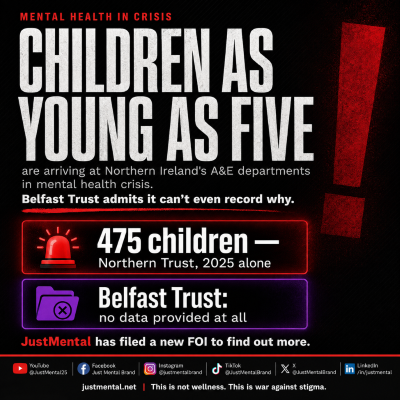
The Northern Trust recorded the highest number of attendances of any trust, with 475 children and young people presenting with mental health concerns in 2025 alone. The Western Trust’s figures fell over the same period, from 235 attendances in 2021 to 136 in 2025. Across the trusts that did report, children as young as five, six and seven were recorded among those attending.
Belfast Health and Social Care Trust, Northern Ireland’s largest, could not provide any figures at all. The reason given was that “reasons for attendance are not consistently recorded or clinically coded” within its Emergency Departments.
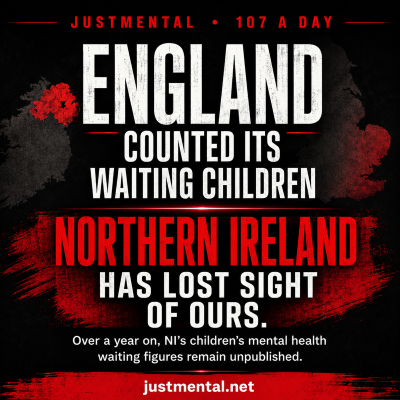
If that sounds familiar to regular readers, it should. It’s the same trust, and largely the same excuse, behind the gap in Belfast’s CAMHS waiting time statistics that JustMental has already been pressing the Department of Health on. Two separate children’s mental health datasets. Same trust. Same blind spot.
What we still don’t know
Unlike the English figures, Northern Ireland’s release contains no breakdown of how long these children waited once they arrived, no detail on presenting reason, self-harm, eating disorders, or other crises, and, as far as we’ve been able to establish, no published figures at all for South Eastern or Southern Trust. There is also no single Northern Ireland-wide total.
This isn’t an isolated case of one trust falling short on transparency. South Eastern Trust has separately been criticised by the New Script for Mental Health campaign for failing to provide waiting-time breach data for adult mental health and psychological therapies, only routinely publishing that data from March 2026 onwards. The pattern across Northern Ireland’s mental health data is one of gaps, not just in one place, but running through the system.
What JustMental is doing about it
We’ve submitted a new Freedom of Information request to the Department of Health, asking for the figures the 7 August release didn’t include: full five-trust attendance data, a breakdown by presenting reason, wait-time bands comparable to those published in England, and a clear explanation from Belfast Trust of when, if ever, it expects to be able to record this information properly.
We’ll also be putting this directly to new Health Minister Robbie Butler, who takes on this brief at a moment when the English data has just set a new benchmark for what transparency on this issue should look like.
Every young person turning up at A&E in crisis is a young person the system failed to reach earlier. Northern Ireland deserves to know how many that is, not an estimate, not a partial trust-by-trust picture, but the whole number, properly counted.
If you or someone you know is struggling, support is available:
Lifeline NI: 0808 808 8000 Samaritans: 116 123 CALM: 0800 58 58 58 SHOUT: Text 85258 Childline: 0800 1111