
Living Well with Bipolar | JustMentalTalk Podcast
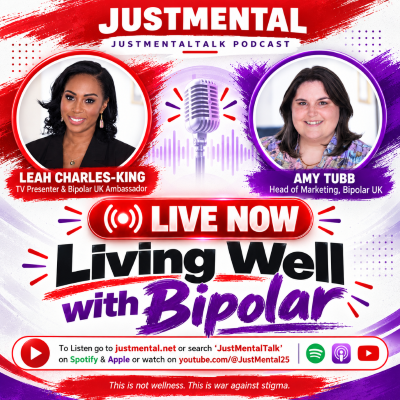
Living well with bipolar is not a phrase most people associate with the condition. For too many, a bipolar diagnosis still lands with the weight of a life sentence. This week on JustMentalTalk, we sat down with two women who are working to change that story, Leah Charles-King, Bipolar UK Ambassador and A Place in the Sun presenter, and Amy Tubb, Head of Marketing and Communications at Bipolar UK.
Their conversation was one of the most honest we have hosted since JustMental launched in November 2025. It moved between the clinical and the deeply personal, and it left us with a simple, powerful message: a bipolar diagnosis does not have the final say.
What does living well with bipolar actually look like?
For Leah, learning to live well with bipolar took time, and it started with a shift in how she thought about the condition itself.
“I am not bipolar. It’s something that I have.” Leah Charles-King
It is a small sentence with an enormous consequence. When bipolar becomes something you have, rather than something you are, the door opens to a life that is bigger than the diagnosis. Leah calls the condition her “sleeping dragon.” When it stirs, she knows which tools to reach for. Most of the time, she says, it sleeps quite well.
That control did not arrive overnight. Leah hid her diagnosis for seven years, terrified of the stigma. When she finally spoke publicly in April 2019, she describes it as coming “out of the bipolar closet in spectacular fashion.” It changed her life.
The nine and a half year diagnostic delay
Bipolar UK’s own research, through the Bipolar Commission, shows an average diagnostic delay of nine and a half years between someone first seeing a doctor about symptoms and receiving an accurate diagnosis. Around 56% of people living with bipolar in the UK are estimated to be currently undiagnosed.
Leah’s own journey mirrored that national average almost exactly. She was repeatedly misdiagnosed with depression, prescribed antidepressants which, without a mood stabiliser, can actually worsen bipolar symptoms. Amy explained what Bipolar UK sees again and again through its peer support services, people who have been asking for help for years, being missed by a system that is not looking for what is actually there.
“Bipolar UK as a charity is literally saving lives, because there aren’t many other places you can go to when you’re in that situation.” Leah Charles-King
Not one condition: the different types of bipolar
One thing that surprised us during our research for the episode was learning that bipolar is not a single condition. There are several distinct types, and understanding them matters for anyone trying to make sense of what they, or someone they love, might be experiencing.
- Bipolar I: characterised by full manic episodes, often alongside episodes of severe depression.
- Bipolar II: involves hypomanic episodes (less severe than mania) plus episodes of depression.
- Cyclothymia: milder mood swings that do not reach the intensity of bipolar I or II, but can still be highly disruptive.
- Mixed features: symptoms of both depression and mania appearing at the same time.
- Rapid cycling: four or more mood episodes within a twelve month period. Bipolar UK reports this affects around one in ten people living with bipolar.
Leah was diagnosed with bipolar I alongside generalised anxiety disorder. For her, understanding the type she lives with, and how it shows up specifically in her, was central to finding stability.
The Maybe It’s Bipolar campaign
Amy is the person driving Bipolar UK’s flagship awareness campaign, Maybe It’s Bipolar. The campaign is designed to shorten exactly the kind of journey Leah went through, helping people, and clinicians, to recognise the signs earlier.
At the heart of the campaign is a free online bipolar test people can take if they are wondering whether the condition might apply to them or someone they love. Over 20,000 people have taken it. The campaign film, created by Bipolar UK ambassadors Rosie Viva and April Kelley, won Silver People’s Choice at the 2026 Smiley Charity Film Awards.
Where to find support for bipolar
Bipolar UK is the only national charity in the UK dedicated solely to supporting people affected by bipolar, and its offer is built around peer support, the person you are speaking to has been there themselves and truly understands. This complements the wider Northern Ireland mental health picture we have covered on the podcast previously, including our conversation with Professor Sióbhán O’Neill, Mental Health Champion for Northern Ireland.
- Support: Visit bipolaruk.org/get-support for the eCommunity, Peer Support Line, email service and network of local peer support groups across the UK.
- Take the bipolar test: The Maybe It’s Bipolar campaign includes a free online test and resources for the diagnosis journey.
- Leah’s book: Thriving with Bipolar: A Personal and Practical Guide to Living Well is available on Amazon and via thrivingwithbipolar.co.uk.
- Leah online: Follow Leah at @leahcharlesking on Instagram, TikTok and Facebook.
- Bipolar UK online: @bipolar_uk on Instagram and Bipolar UK on Facebook.
A message of hope
“I want you to know that there is life after diagnosis. It’s scary. Believe you me, I get it. It took a long time to smile. It took years to smile. And actually, I believe that you can get there even quicker than I have.” Leah Charles-King
If you take one thing away from this week’s episode, let it be this: you are not alone. Whether you have just been diagnosed, are wondering whether the description in this article sounds like you, or are watching someone you love live with the condition, there is a road out of the dark.
Living well with bipolar is genuinely possible, and there are two brilliant women on this week’s episode doing the work every day to make sure more people know that.
How to watch, listen and share
The full episode of JustMentalTalk with Leah Charles-King and Amy Tubb is available now on our podcast archive, on YouTube (@JustMental25), Spotify, Apple Podcasts, and across our social platforms at @JustMentalBrand. If something in this conversation moved you, share it with someone who needs to hear it. That is how stigma actually breaks, not with hashtags, but with one honest conversation at a time.
If you are struggling today or tonight, Lifeline Northern Ireland is available 24 hours a day on 0808 808 8000. Samaritans is on 116 123. Both are free, both are confidential, and both are there for you.