
Addiction Recovery: 7 Honest Truths From a Counsellor
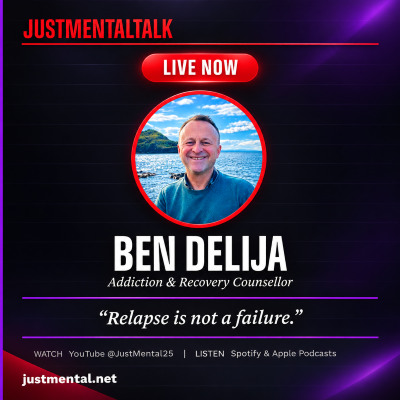
Addiction recovery is not a straight line, and Ben Delija wants more people to hear that before they decide they have failed. Ben is an Addiction & Recovery Counsellor with nearly 20 years in the field, and this week he joins us on JustMentalTalk for an honest conversation about what addiction really is and what recovery really looks like.
Whether you are struggling yourself, worried about someone you love, or simply want to understand, here are seven honest truths about addiction recovery from our conversation, in Ben’s own words wherever we can.
Content note: this episode discusses addiction and substance use. If it lands close to home, you are not alone. Lifeline NI is free on 0808 808 8000 and Samaritans is free on 116 123. Both are open 24 hours a day.
Who is Ben Delija?
Ben is originally from Albania. In 2006 he began volunteering one night a week at a church homeless shelter in Burton upon Trent, with no background in addiction. “It was just about making a difference,” he says. By 2008 he was working in detox and rehab services, rising from support worker to supervisor to manager, and he has now spent nearly two decades in addiction recovery work.
He moved to Northern Ireland in 2015 and, by his own account, was one of the first people here to set up SMART Recovery meetings. He was later named Campaigner of the Year at the SMART Recovery Volunteer Recognition Awards for his work on the Unite for Recovery campaign. Ben joins us in a personal capacity.
Why addiction recovery matters in Northern Ireland
The scale is hard to ignore. NISRA reports that 397 alcohol-specific deaths were registered in Northern Ireland in 2024, up from 219 in 2014, a rise of 81.3%. In the same year, 251 drug-related deaths were registered. Registration figures can lag the date of death, so year-to-year comparisons need care, but the long-term rise in alcohol-specific deaths is clear. Behind every number is a person, and usually a family. That is why honest conversations about addiction recovery matter.
1. Relapse is not a failure
This is the line Ben comes back to, and the one we built the episode around. “I treat relapse as part of the recovery journey,” he says. “And relapse is not a failure.” In other words, a setback in addiction recovery is not the end of the story.
Clients often arrive full of guilt, and many apologise for letting him down. Ben’s response is to say, in his words, “Come here, mate, I’ll give you a hug.” A relapse, he explains, is a learning stage: what happened, and what triggered it? Sometimes it follows a loss. Sometimes, surprisingly, it follows a good patch, when everything seems to be going well but something still feels missing.
His advice is simple. Do not beat yourself up, and seek support quickly. The sooner someone gets back on track, the easier it tends to be.
2. Addiction can happen to anyone
“It doesn’t matter if you’re rich or you’re poor,” Ben says. “Addiction could happen to anyone.” That means addiction recovery has to be open to anyone too.
It does not always start with trauma. Ben has worked with professionals whose drinking crept up during the isolation of lockdown, with a man who had hardly drunk until he was made redundant, and with a woman whose use of painkillers began after a back injury.
“Addiction is not a choice,” he says. “People don’t wake up one day and then choose to use substances.” For many, substances are a way to numb pain, to sleep, or to forget.
3. It is rarely just about the substance
Ben describes substances as a form of self-medication. People tell him a substance helps them sleep or eases their anxiety. So the real question is not “why can’t they just stop?” but “what is this doing for them?” Addiction recovery has to look beyond the substance.
He is open about the different ways addiction is understood. As Ben describes it, bodies such as the US National Institute on Drug Abuse see it as a chronic relapsing brain disease. SMART Recovery sees it as a learned behaviour and focuses on self-empowerment and science-based tools such as cognitive behavioural therapy. Ben himself looks through the lens of attachment: adverse childhood experiences, or growing up without feeling loved, can leave people more vulnerable. He respects them all.
4. Addiction is wider than drink and drugs
Gaming, gambling, work, shopping and even the gym can become addictions, Ben says, often because they offer the same thing: a release of dopamine, the brain’s feel-good chemical. Someone who is isolated can drift into online gaming to find company. Gambling can lead to debt, then to a lost job or home, and then to substances. Someone newly in recovery who finally has a little money in their pocket can swap one compulsion for another.
There is an encouraging side. That drive can be redirected, and for many people it becomes part of their addiction recovery. Ben points to people who move from a harmful habit to running or the gym, and to the buzz many people in recovery get from helping others.
5. Labels are for bottles and jars, not for people
It still annoys Ben to hear someone called a drug addict or an alcoholic. “Labels are for bottles and for jars, not for people,” he says, a phrase he loves from SMART Recovery. He argues that everyone from GPs to hospital staff should choose their words with care, and say “a person with substance use” rather than defining someone by their addiction. Language is part of addiction recovery too.
Ben has never forgotten a man who arrived at the homeless shelter where he volunteered. Offered soup and sandwiches, the man hesitated, ate, then grew angry when offered more. “What do you want from me?” he asked. He was not used to being treated well. It took time, but three months later that same man was helping Ben at the shelter. The lesson, for Ben, is to treat people as human beings and to look behind the substance.
6. Addiction recovery looks different for everyone
Ben is firm that addiction recovery is possible, “with all my heart”, but he calls it a journey rather than a finish line. For some people it means abstinence. For others it means reducing their use, or staying on prescribed substitute medication so that they are not using other hard drugs. “Whatever changes they’ve made,” he says, “I believe it’s still a change.”
What addiction recovery brings goes well beyond the substance: better mental and physical health, steadier finances and better communication with family and professionals. Ben still hears from former clients. One recently marked four years sober, and for Ben that feels “like winning a million pounds”. Another had just been accepted onto a master’s course in cognitive neuroscience.
7. The first call is the hardest, and help is closer than you think
Starting addiction recovery often begins with one phone call. To anyone too ashamed to ask for help, Ben says: “Make that first phone call.” A GP is a very good start, he says, as long as you are honest about what you want. You can also self-refer to addiction services in Northern Ireland by finding which service covers your trust area. Through your GP, a community addictions team can arrange medical support such as detox, or a referral to rehab. Those teams focus on substances, so help for gambling and other behavioural addictions usually comes through charities.
SMART Recovery meetings run online and face to face. Ben stresses that they are about how things are now, not what happened twenty years ago.
If you are worried about someone else, get support for yourself too. Ben says family support is available in every trust area, including free counselling, and SMART Recovery Family & Friends meetings are free, confidential and available online. Instead of asking “why don’t you stop?”, he suggests: “Let’s go and talk to the GP together.”
Where to get addiction recovery support
- Lifeline NI: 0808 808 8000, free, 24 hours a day
- Samaritans: 116 123, free, 24 hours a day
- Your GP: a good first step, and you can self-refer to services in your trust area
- SMART Recovery: meetings online and in person, plus Family & Friends meetings for loved ones
- Northern Ireland Alcohol and Drug Alliance (NIADA): mentioned at the end of the episode as a way to find an organisation that can help
Watch and listen
Watch the full addiction recovery conversation above, or find JustMentalTalk on YouTube at @JustMental25, on Spotify and on Apple Podcasts. More conversations that refuse to whisper about mental health are on our homepage.
If something in this conversation moved you, share it with someone who needs to hear it. That is how stigma breaks, one honest conversation at a time.
This article is for information and is not medical advice.