
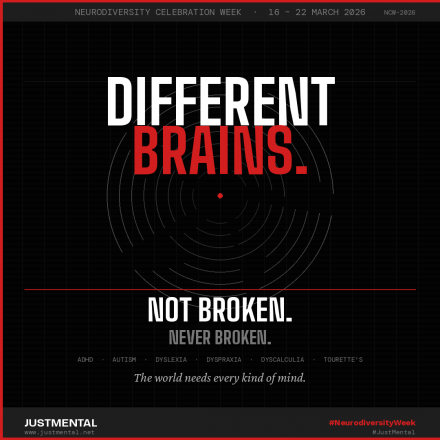
Different Brains. Not Broken. Never Broken.
This week, 16th to 22nd March 2026, marks Neurodiversity Celebration Week. It is a week that, on the surface, asks us to acknowledge and appreciate the full spectrum of human neurological difference. ADHD. Autism. Dyslexia. Dyspraxia. Dyscalculia. Tourette’s Syndrome. And many more besides.
At JustMental, we do not simply acknowledge. We dig deeper. Because celebration without honesty is just noise, and the neurodiverse community deserves far more than noise.
What Neurodiversity Actually Means
The term neurodiversity, first coined by sociologist Judy Singer in the late 1990s, describes the natural variation in human brain function and behavioural traits. It is not a medical diagnosis. It is not a label of limitation. It is a recognition that human brains do not all work the same way, and that this is not a flaw in the design. It is the design.
Neurodiversity encompasses a broad range of conditions, including Attention Deficit Hyperactivity Disorder (ADHD), Autism Spectrum Condition (ASC), Dyslexia, Dyspraxia (also known as Developmental Coordination Disorder), Dyscalculia, and Tourette’s Syndrome. Estimates suggest that somewhere between 15 and 20 per cent of the UK population is neurodiverse in some form, meaning that in every classroom, every workplace, every family, and every community, neurodiverse people are present. Often silently. Often struggling. Often unseen.
The Mental Health Reality
Here is where celebration must give way to honesty.
Neurodiverse people are disproportionately affected by mental health difficulties, not as an inherent feature of their neurodiversity, but as a direct consequence of living in a world that was not built with them in mind. The research is consistent and clear.
Adults with ADHD are up to three times more likely to experience depression and anxiety than their neurotypical peers. Autistic adults face significantly elevated rates of suicidal ideation, with studies suggesting autistic people are approximately nine times more likely to die by suicide than the general population. Those with dyslexia and dyspraxia report higher levels of anxiety and lower self-esteem, often rooted in years of being labelled as lazy, careless, or simply not trying hard enough.
These are not small numbers. These are not edge cases. These are the lived realities of millions of people across the UK, including right here in Northern Ireland.
A System That Has Consistently Failed
The mental health system has, for too long, approached neurodiversity through a deficit lens. Neurodiverse people have been assessed against neurotypical standards, medicated to conform, and, in many cases, simply not diagnosed at all.
The issue of late and missed diagnosis is particularly acute. Women and girls have historically been dramatically underdiagnosed with both ADHD and autism, in part because diagnostic criteria were developed overwhelmingly from studies of white boys. Many neurodiverse adults reach their thirties, forties, fifties, and beyond before receiving a diagnosis that finally makes sense of a lifetime of struggle. That delay has consequences. Years of self-blame, of fractured mental health, of accessing entirely the wrong kind of support, or no support at all.
In Northern Ireland specifically, the context is even more challenging. Mental health services here are under sustained and well-documented pressure. Waiting lists for ADHD and autism assessments stretch to years for many, a crisis that compounds the mental health difficulties already being experienced. Access to specialist neurodiverse-informed therapy remains limited, patchy, and frequently dependent on the postcode in which you happen to live.
This is not a personal failing on the part of neurodiverse individuals. It is a systemic failure. And it needs to be named as such.
What Genuine Celebration Looks Like
Neurodiversity Celebration Week was established with an important purpose, to shift the cultural narrative away from deficit and towards strength. And that purpose is right. Neurodiverse people bring extraordinary qualities to every field of human endeavour. The hyperfocus of ADHD. The pattern recognition of autism. The visual-spatial thinking of dyslexia. These are not compensations for weakness. They are strengths in their own right.
But genuine celebration cannot be performative. It cannot begin on the 16th of March and quietly pack itself away on the 23rd. It requires the harder work, of pushing for earlier diagnosis, of demanding neurodiverse-informed mental health services, of creating workplaces and educational environments that accommodate rather than penalise difference, and of ending once and for all the narrative that neurodiverse people need to be fixed.
At JustMental, this is not a week-long commitment. It is a permanent one.
The Conversation Continues Here
We are calling on our community this week to share their experiences. If you are neurodiverse, we want to hear your story. If you received a late diagnosis that changed your understanding of yourself, we want to hear about it. If you have felt failed by mental health services, let’s talk about it openly.
This platform exists precisely for these conversations. No corporate language. No sanitised wellness messaging. Just honest, direct dialogue about the things that actually affect people’s lives.
You can join the conversation across all our social media channels, YouTube (@JustMental25), Instagram (@justmentalbrand), Facebook (Just Mental Brand), TikTok (@JustMentalBrand), and X (@JustMentalBrand) — or email us directly at info@justmental.net.
This is not wellness. This is war against stigma.
🖤 The JustMental Team
If you are struggling with your mental health, you do not have to face it alone. Lifeline NI offers free, confidential support 24 hours a day, 7 days a week, call 0808 808 8000. Your GP can also be your first point of contact for a referral to mental health or neurodiversity assessment services.