
Exam Stress and Student Mental Health: The Numbers That Should Concern Every School in Northern Ireland
Exam stress mental health challenges in young people have reached a level that demands more than awareness. It demands action. As April draws to a close and exam season begins in earnest, JustMental has examined the latest evidence, and the picture it paints should concern every school, university, parent and policymaker in Northern Ireland.
GCSE and A-Level examinations begin in May. University students face dissertation deadlines, finals, and the compounding pressure of an uncertain job market. And the data on how all of this lands on young people’s mental health is, to put it plainly, alarming.
JustMental has drawn on evidence from two significant sources: Childline’s 2024–25 counselling data on GCSE A Level mental health contacts, and a 2026 survey of over 2,000 UK students. Together, they paint a picture that cannot be looked away from.
Exam Stress Mental Health: What the Data Actually Shows
The Scale of the Problem
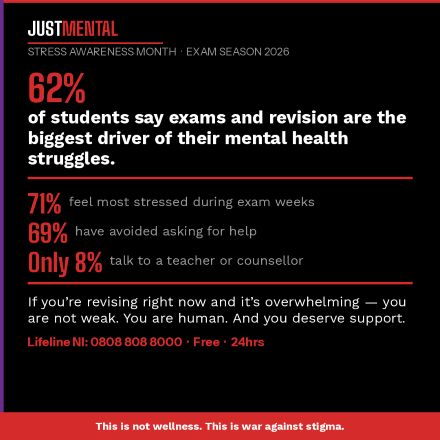
According to a survey of 2,097 UK students conducted in March 2026, 62% of students identify exams or revision as the biggest driver of their mental health struggles. That is not a minority experience. That is six in ten young people telling researchers that the thing most responsible for damaging their student mental health in Northern Ireland and across the UK is the very system they are required to participate in.
The same survey found that 71% of students feel most stressed during exam weeks. A third get fewer than six hours of sleep during exam periods. And 32% of female students say exam pressure significantly harms their mental health, nearly double the rate reported by male students.
The Silence Problem
Perhaps the most striking finding is not about the stress itself but about what young people do with it. Nearly seven in ten students, 69%, have avoided asking for help due to stress, anxiety or embarrassment. And only 8% turn to a teacher or school counsellor when they are struggling.
That 8% figure deserves to sit with every school leader, every pastoral care team, and every mental health policy in Northern Ireland. The overwhelming majority of students who are struggling are not telling the people in schools who are there to help them. They are carrying it alone.
What Childline Exam Stress Data Tells Us
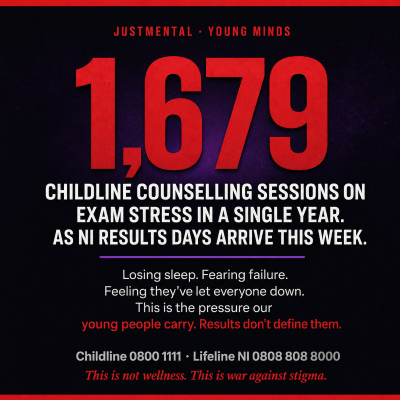
Childline’s figures for 2024–25 add a further dimension to the revision anxiety young people experience. Between April 2024 and March 2025, Childline delivered 1,647 counselling sessions in which the young person specifically mentioned exam or revision stress, an average of 137 sessions per month. Those sessions peaked in May 2024 with 359 contacts, more than two and a half times the monthly average.
Where age was recorded, half of those sessions were with young people aged 12 to 15. Around 39% were aged 16 to 18. But the figure that should stop every reader: 11% of those Childline exam stress counselling sessions were with children aged 11 and under.
Eleven years old. Reaching out to a crisis counselling service because they are overwhelmed by exam pressure.
Childline Director Shaun Friel: “Young people are telling our counsellors about losing sleep over exams, feeling pressured by themselves and family members, and struggling to balance revision with other important parts of their lives. Many feel guilty about taking breaks and worry about letting people down if they don’t achieve the results they hope for.”
What Young People Are Actually Experiencing
The qualitative picture behind these statistics matters as much as the numbers. Students describe feeling caught between knowing they need breaks and feeling guilty for taking them. They describe the fear of failing, not as an abstract worry but as something that generates hopelessness about their entire future. They describe comparing themselves to peers, particularly on social media, in ways that amplify rather than contextualise their anxiety.
One 16-year-old told Childline: “I already know that I’m going to fail. Everyone keeps saying to do my best, but I can’t when I feel like this.”
That is not a student who needs more revision tips. That is a young person in genuine distress who needs support, perspective, and someone to hear them. And yet only 8% are reaching the people in schools who could provide exactly that.
The Northern Ireland Context
Student mental health in Northern Ireland sits within a broader crisis. Northern Ireland has the highest suicide rate in the United Kingdom. It has some of the longest mental health waiting times in these islands. And it has a generation of young people whose education was significantly disrupted during the pandemic, whose mental health consequences are still being felt today.
Against that backdrop, an exam season in which the majority of students are struggling and the vast majority are not seeking help is not a minor pastoral concern. It is a mental health emergency playing out quietly, one revision session at a time, in bedrooms across Northern Ireland.
JustMental is not opposed to academic rigour or to exams as a form of assessment. What we are opposed to is a system that generates this level of distress and then provides inadequate support for the young people experiencing it.
JustMental has also explored the wider picture of stress this April in our Stress Awareness Month accountability piece, available at justmental.net.
What Schools and Families Can Do
- Normalise asking for help. The 8% figure is a reflection of stigma and fear of judgement, not resilience. Schools that actively signal that struggling is normal see higher help-seeking rates.
- Talk about it early. Childline exam stress data shows contacts rising sharply as May approaches. Conversations in April, before the crisis peaks, are more effective than responses to crisis when it arrives.
- Separate performance from worth. The message that exam results do not define a young person’s value is one that cannot be repeated too often, not as a platitude, but as a genuine institutional position.
- Acknowledge the pressure without dismissing it. Sitting with a young person in their difficulty, validating that it is genuinely hard, and offering practical support is far more effective than telling them everyone finds exams hard.
Where Young People Can Get Support
If you are a young person reading this and exam season is overwhelming you right now, please do not sit with it alone.
- Childline: 0800 1111 — free, confidential, available 24 hours. You can also chat online at childline.org.uk
- Lifeline NI: 0808 808 8000 — free, confidential, 24 hours a day
- Your school’s pastoral care team or school counsellor
- A trusted adult, a parent, an older sibling, a teacher you trust
Exam results matter. But they do not matter more than you do.
This is not wellness. This is war against stigma.
Childline: 0800 1111 · Lifeline NI: 0808 808 8000 · Both free · Both 24 hours.