
JUSTMENTAL STATEMENT | MPs Reject Social Media Ban
Go To The Root.
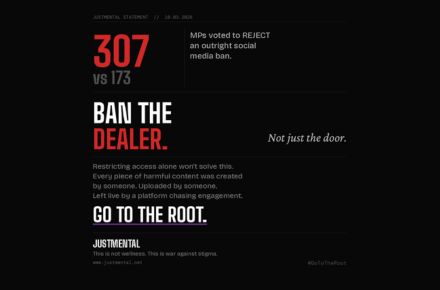
Yesterday, MPs voted 307 to 173 to reject an outright ban on social media for under-16s, defeating a Lords amendment to the Children’s Wellbeing and Schools Bill. In its place, Education Minister Olivia Bailey’s alternative plan was backed, granting ministers flexible powers to introduce restrictions, whilst a government consultation runs until 26th May.
JustMental’s position is straightforward.
Some form of age restriction on social media, applied with appropriate flexibility and enforced with genuine teeth, still has merit. We are not dismissing that debate. The instinct behind the Lords amendment, that children need stronger protection online, is the right one, even if a blanket ban carries risks of pushing young people towards darker, less regulated corners of the internet.
But the harder conversation, the one that Westminster keeps sidestepping, is this: you cannot solve this problem from the access end alone. You must go to the root of it.
Every piece of content that glamourises suicide, normalises self-harm, and nudges vulnerable people towards their darkest moments was created by a person. It was deliberately uploaded. It was allowed to remain live, in many cases actively amplified by platform algorithms, because engagement, however toxic, drives profit.
One MP made the analogy during yesterday’s debate that if social media were a pharmaceutical drug causing measurable harm to 78% of its users, it would be immediately withdrawn, reformulated, or placed under strict access controls. He is correct. But even that comparison falls short, because we know where drugs come from. We know who manufactures them. The law pursues them.
So why are we not pursuing, with the same aggression, the individuals who create and distribute content designed to harm? Why are platforms not legally compelled to actively identify, report, and assist in the prosecution of those responsible, rather than simply blocking a search term after the damage is done?
Consultations produce reports. Prosecutions protect lives.
It is also vital to state clearly: the harm caused by dangerous online content does not stop at the age of 16. Mental health does not discriminate. The algorithm does not check your date of birth before it serves you content about suicide methods or self-harm.
The vulnerable adult, the veteran, the new mother, the man in his fifties who has never spoken to anyone about his mental health, is just as exposed, just as at risk, and just as deserving of protection.
At JustMental, we welcome any genuine move toward a safer online environment. We support age-appropriate restrictions. We support the removal of addictive platform features that are designed to keep people, of all ages, hooked.
But we will keep saying what others seem reluctant to say: the most powerful thing any government can do is go after those creating the content that is costing people their lives.
Ban the dealer. Not just the door.
JustMental
This is not wellness. This is war against stigma.
www.justmental.net