
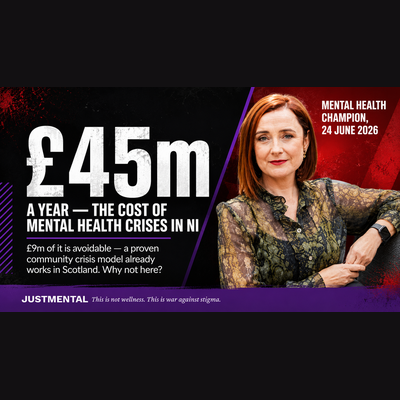
Mental Health Crises Cost NI £45 Million a Year, We Know How to Cut It | JustMental
Mental Health Crises Cost Northern Ireland £45 Million a Year. We Know How to Cut It. So Why Isn’t It Happening?
This is not wellness. This is war against stigma.
On 24 June 2026, Northern Ireland’s Mental Health Champion, Professor Siobhan O’Neill, launched a new report that does something rare in this space: it puts a hard number on what mental health crises actually cost, and shows exactly how much of it doesn’t need to be spent.
The Cost of Mental Health Crises, in Numbers
The Economic Case for a Mental Health Regional Crisis Intervention Service in Northern Ireland, commissioned by the Mental Health Champion and authored by David McDaid, conservatively estimates the immediate cost of mental health crises to the health care system, ambulance service, social work, PSNI and families in Northern Ireland at more than £45 million every year.
The same report finds that community-led crisis intervention could save the system more than £9 million annually, mainly by reducing avoidable Emergency Department attendances.
The model behind that saving already exists and already works. Scotland’s Distress Brief Intervention (DBI) programme provides 14 days of compassionate, community-based support to people in crisis, at a cost of £392 per person, compared with £544 for a single Emergency Department visit in Northern Ireland. The report’s evidence suggests more than two-thirds of people in crisis could be safely and effectively supported this way, freeing up specialist and emergency services for those with the most acute needs.
Professor O’Neill also pointed to the human scale behind the economics: NI’s self-harm registry has recorded a 74% increase in Emergency Department presentations for suicidal ideation, alongside a rise in suicide rates since 2017. Her point is straightforward, an Emergency Department is not always the right place for someone in crisis, and can, in some cases, contribute to escalating distress rather than easing it.
Why this backs up what we’ve been saying
This isn’t JustMental’s data. It’s independent, official, and commissioned by the Mental Health Champion’s office, and it lands squarely behind the case we’ve been making through our own 107 a Day campaign.
Our campaign is built on PSNI’s own figures: roughly 39,000 concern-for-safety calls a year, around 107 a day, costing PSNI an estimated £4 million annually, a figure PSNI itself gave in evidence to Stormont. Our central demand has been simple: a costed, time-bound commitment to 24/7 Mental Health Crisis Response Teams across all five Health and Social Care Trusts, to properly support the incoming Right Care, Right Person handover from police to health services.
Professor O’Neill’s report arrives at the same conclusion from a completely different angle, the economics of Emergency Department overuse rather than policing costs, and it lands on the same answer: community-led, properly funded crisis response saves money and saves distress. When two independent evidence bases point at the same solution, that’s not coincidence. That’s a system telling you what it needs.
What needs to happen
- The Executive should treat this report, alongside the evidence underpinning 107 a Day, as confirmation that a Regional Mental Health Crisis Intervention Service is not a nice-to-have, it is the fiscally responsible option
- A funding decision, not another review, ahead of the Right Care, Right Person rollout
- Clear public reporting on how any new crisis service interacts with existing PSNI, ambulance and Emergency Department pathways, so people in crisis are met by the right service the first time
- Investment weighed against the £45 million already being spent reactively, because the honest comparison isn’t “can we afford a crisis service,” it’s “we’re already paying for the absence of one”
We’ll continue to track the Executive’s response to both this report and our own campaign, and report back plainly on what changes and what doesn’t.
If you or someone you know is in crisis, Lifeline NI is free and confidential, 24/7: 0808 808 8000. Samaritans: 116 123.