
Nearly a Third of NI’s Senior Psychiatry Posts Are Vacant, And Nobody’s Counting the People Waiting
New figures published today by the Royal College of Psychiatrists paint a sobering picture of mental health services in Northern Ireland, and one that should prompt urgent political action.
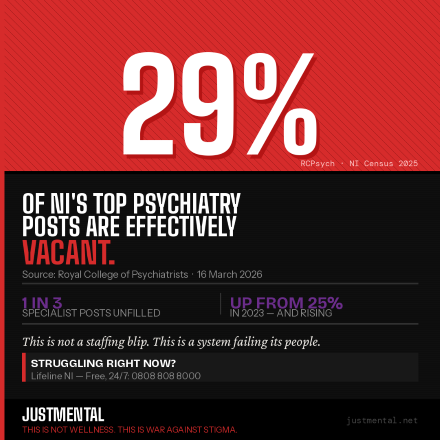
According to the RCPsych’s latest workforce census, which gathered information in 2025 from all five health trusts in Northern Ireland, 29% of consultant psychiatry posts are either vacant or covered by locum doctors. That figure has risen from 25% in 2023. rcpsych
The pressures extend beyond consultants. Of 79 specialist and specialist (SAS) psychiatrist posts across Northern Ireland, only 52 are filled by permanent doctors, meaning around one in three senior specialist roles are not permanently staffed, up from approximately one in three in 2023. rcpsych
These are not abstract statistics. They represent the gap between the number of senior clinicians Northern Ireland needs and the number it currently has, a gap that is growing, not shrinking.
Underfunding in a region that needs more, not less
The report also highlights that Northern Ireland continues to receive less mental health funding per person than other parts of the UK, despite having a demonstrably greater mental health need. rcpsych The legacy of the Troubles, intergenerational trauma, rural isolation and persistent socioeconomic deprivation have all contributed to elevated rates of mental ill health across the region, yet investment consistently lags behind need.
The Department of Health said it was acutely aware of the challenges facing the psychiatry workforce, and confirmed that the Mental Health Strategy Review of Deliverability 2026–2029 had found that just 16% of the funding expected at this stage had been allocated from existing resources. The Irish News
The data we’re not collecting
Perhaps one of the most troubling elements of today’s report is what is absent rather than what is present. The Department of Health does not routinely publish mental health waiting list data, meaning the true scale of unmet need in Northern Ireland remains unclear. rcpsych Without that data, it is impossible to hold the system fully to account, or to know how many people are living without the support they need.
Dr Julie Anderson, Chair of the Royal College of Psychiatrists in Northern Ireland, said: “These figures show the true scale of the workforce pressures facing mental health services in Northern Ireland. Behind these numbers are people, some of them vulnerable, who are waiting far too long for the support they so desperately need.” rcpsych
Why this matters beyond the numbers
At JustMental, we exist because we know that stigma is not the only barrier people face when it comes to mental health. The system itself, understaffed, underfunded, and in some cases unable to measure its own shortcomings, is a barrier too. Today’s report from the Royal College of Psychiatrists confirms that reality in the starkest possible terms.
Meaningful change requires political will, sustained investment, and a genuine commitment to transparency, including the routine publication of waiting list data that allows the public to understand what is actually happening.
We will continue to cover developments in mental health policy and services in Northern Ireland as they emerge.
Read the full Royal College of Psychiatrists report at: https://www.rcpsych.ac.uk/news-and-features/latest-news/detail/2026/03/16/more-than-a-quarter-of-consultant-psychiatry-posts–effectively-vacant–in-ni
If you are struggling, Lifeline provides free, confidential support 24 hours a day on 0808 808 8000.