
Northern Ireland psychiatry workforce crisis: 72% want out
Northern Ireland psychiatry workforce: built to break
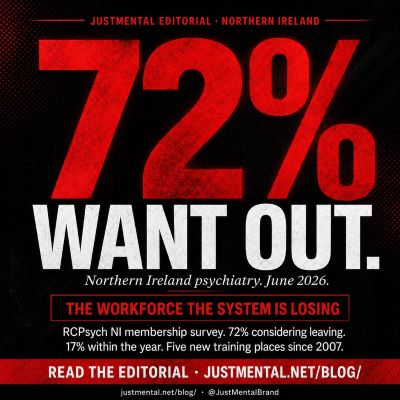
The Royal College of Psychiatrists’ new survey says 72% of the Northern Ireland psychiatry workforce are considering leaving. Multiple Health Ministers. Nineteen years. Five new training places. This crisis was not an accident.
By Karl Bennett, JustMental
The Northern Ireland psychiatry workforce is in collapse, and the people who would know best are the ones telling us.
In a new membership survey published last week, the Royal College of Psychiatrists in Northern Ireland (RCPsych NI) reports that 72% of its members are considering leaving their current role. Seventeen percent are considering quitting within the next year. A third of NI psychiatrists are experiencing work-related stress or burnout every single week. Thirty-one per cent of consultant and specialty psychiatrist posts are currently vacant across NI.
Source: Royal College of Psychiatrists in Northern Ireland membership survey, June 2026, communicated to JustMental by RCPsych NI directly.
The Northern Ireland psychiatry workforce: the numbers in context
These figures do not appear out of nowhere. The Northern Ireland psychiatry workforce has been reporting itself in distress for years. The data is on the public record, from the same College that is now sounding the alarm again:
- October 2025: 89% of NI psychiatrists reported experiencing or witnessing moral injury, clinical distress caused by being unable to meet patient needs because of system pressures. (RCPsych NI, October 2025.)
- March 2026: 29% of consultant psychiatry posts in NI “effectively vacant” (vacant or covered by locums). Up from 25% in 2023. Up from 16% in 2017.
- March 2026: 34% of Specialty and Specialist (SAS) psychiatrist posts “effectively vacant.” Up from 29% in 2023.
- January 2025: NI has the worst psychiatry vacancy rate in the UK, and the Mental Health Strategy 2021–2031 is funded at £15.5 million against a stated need of £76.7 million. That is 20.2% of what is required.
- Over the four years to 2024, mental health waiting lists in NI grew by 30%.
None of those data points is the College being dramatic. They are the predictable, documented end-state of two decades of structural underinvestment in the workforce that the mental health system depends on.
The figure that explains the Northern Ireland psychiatry workforce collapse
From 2007 to May 2025, eighteen years, the number of psychiatry training places in Northern Ireland did not increase by one.
In the same period, England added 417 new psychiatry training places. Scotland added 30. Wales added 15. Northern Ireland: zero.
The current Health Minister, Mike Nesbitt MLA (UUP), announced an expansion in May 2025: five new psychiatry training posts. RCPsych NI welcomed it as “an important first step in the right direction.”
Five posts. After eighteen years of zero. As a first step.
Thirteen months later, the workforce survey says 72% of NI psychiatrists are considering leaving. Five posts have not closed the gap. Five posts were never going to close the gap. Five posts is what it looks like when a department finally acknowledges a problem that the professional body has been naming since 2007, and responds at a fraction of the scale of the need.
Northern Ireland psychiatry workforce: multiple Ministers, one pattern
Between 2007 and May 2025, the Northern Ireland psychiatry workforce did not get a single new training place added under any of the Health Ministers who held the portfolio. Every party that has held that portfolio in this period, DUP, UUP, Sinn Féin, has the same record on training expansion: zero.
This is not a partisan editorial point. It is a structural one, and the structural point is harder to dismiss than the partisan one would be. Two Assembly collapses sit inside the period. Multiple ministers in and out of office sit inside the period. Through every minister, every collapse, every budget round, every Mental Health Strategy launch, the training place number stayed at zero.
That is not a delay. That is a settled pattern. The pattern is what built the workforce crisis the College is now naming.
Tomorrow, the 107 a Day campaign launches
Tomorrow, JustMental launches the 107 a Day campaign in full. The campaign is built around the figure that PSNI receives 107 concern-for-safety calls every single day in Northern Ireland, almost 39,000 a year, because the mental health system cannot absorb its own demand. Officers in body armour turning up to people who need a clinician.
The 107 a Day campaign tomorrow names the demand side of NI’s mental health crisis. Today’s editorial names the supply side.
Both numbers describe the same broken system from different angles. The crisis the police are absorbing is the crisis the psychiatrists are leaving. The pressure displaces both ways. People in distress cannot reach the system; the workforce inside the system cannot get the resources to meet them. Both sides give up. The cost of giving up is borne by the people in the middle.
The Northern Ireland psychiatry workforce is not the cause of this crisis. They are the canary inside it.
What JustMental is calling for
This is JustMental’s position, and we will be asking for it on the record from every Health Minister who has held the portfolio between 2007 and 2026, and from the current Minister:
- The Department of Health should publish a specific target for new psychiatry training places in NI, with a year-by-year delivery timeline, to be met by the end of the current Mental Health Strategy period (2031). Not aspirational. Specific.
- Mental health waiting list data should be published routinely by the Department of Health. As things stand, the College has noted publicly that the Department does not publish comprehensive regional data on mental health waiting lists. The true scale of unmet need is unclear because the data is not in the public domain. That is unacceptable in 2026.
- The Mental Health Strategy 2021–2031 should be funded to its stated requirement of £76.7 million annually. As of January 2025, it was funded at £15.5 million, 20.2% of what the Strategy itself says it requires. A strategy funded at one fifth of its stated cost is not a strategy. It is a document.
Anyone who has held the Health portfolio between 2007 and 2026 should be asked, on the record, what they did during their tenure to expand psychiatry training places. If the answer is “nothing,” it should be on the record. The figures speak for themselves; the question is whether the people responsible are willing to speak for them too.
The conversation last week
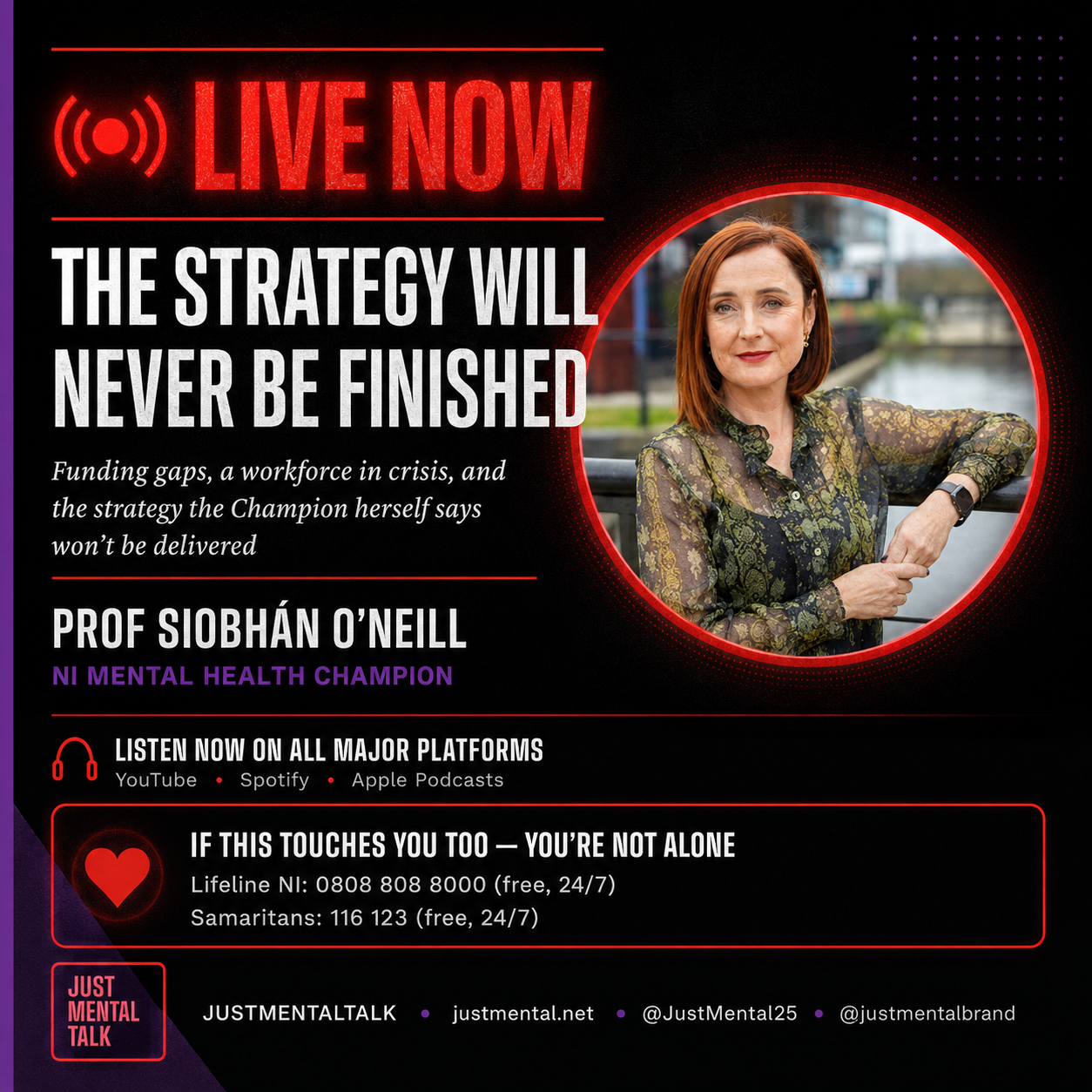
Last Thursday, JustMentalTalk featured Danny Donnelly MLA, the Alliance Party Health Spokesperson and former registered nurse at the Ulster Hospital. He still holds a nursing bank shift. The episode is on the JustMental YouTube channel and on Spotify and Apple Podcasts. The conversation covers the NI health system from inside it.
That episode is not a JustMental endorsement of Alliance Party policy on workforce, nor a criticism of any other party. It is a conversation with one of the very few MLAs at Stormont who has worked on the floor of the system the Assembly votes on. That perspective matters this week particularly.
Crisis support
If you work in mental health services in Northern Ireland and reading this has surfaced something for you:
Practitioner Health — a free, confidential service for NHS staff in the UK, including NI. practitionerhealth.nhs.uk.
BMA Counselling: 0330 123 1245 (24/7).
Samaritans: 116 123.
If you are reading this as someone who has been on a mental health waiting list, or as a family member of someone who has been:
Lifeline NI: 0808 808 8000 (free, confidential, 24/7).
Samaritans: 116 123 (free, 24/7).
In immediate danger: 999.
This is not wellness. This is war against stigma.