
PSNI mental health call-outs: 189 times to one trust’s units in a year
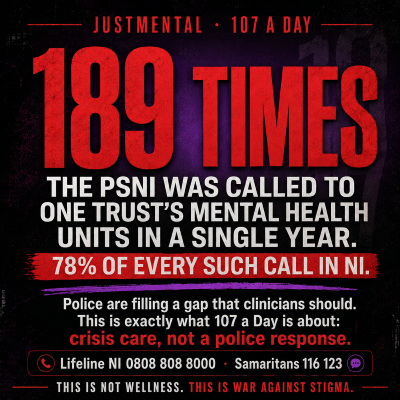
The scale of PSNI mental health call-outs in Northern Ireland has been laid bare again, and it lands squarely on the argument at the heart of our 107 a Day campaign. Figures released by Health Minister Mike Nesbitt in response to an Assembly Question show the PSNI was called to assist staff at inpatient mental health units in the Western Trust on 189 occasions in 2025/26. That single trust accounted for 78% of all such requests across Northern Ireland’s five trusts, which totalled 241.
The same figures show 519 “serious incidents” recorded at mental health units across NI in the year, of which 442, or 85%, were in the Western Trust. It is a stark concentration, and it demands a fair reading as much as an angry one.
What the PSNI mental health call-outs figures really show
We want to be careful here, because the honest story is more useful than the loud one. The Western Trust itself has attributed its high numbers partly to a “strong reporting culture”, meaning it may simply record and report incidents that other trusts do not. It also points to differences in service configuration, bed capacity and patient acuity between trusts. Those are legitimate points, and we make them plainly: these figures are not proof that the Western Trust is uniquely unsafe.
But strip that caveat back and a hard core remains. Whatever the reporting culture, front-line police officers were called to a mental health inpatient setting 189 times in a year in one trust alone. Each of those call-outs is a moment where a person in acute distress met a police response, and where officers were pulled from other duties to manage a health crisis. That is the exact dynamic 107 a Day exists to challenge.
This is the 107 a Day argument, in one trust
These PSNI mental health call-outs are that same problem viewed up close: a system leaning on police to hold people it should be caring for clinically. Our campaign takes its name from the roughly 107 people a day in mental health distress met by a PSNI officer rather than a clinician, a figure drawn from Assistant Chief Constable Ryan Henderson’s evidence to Stormont committees. These Western Trust numbers are that same problem viewed up close: a system leaning on police to hold people it should be caring for clinically.
As Right Care, Right Person is rolled out here, the policy under which police step back from health-related calls, the danger is obvious. If officers withdraw before properly-funded 24/7 mental health crisis teams are in place to take over, the gap does not close. It simply moves onto the shoulders of staff and patients on the wards. The risk is not abstract. If Right Care, Right Person removes the police response before those crisis teams exist, the distress does not disappear, it simply falls on whoever is left in the room. That means ward staff already stretched thin, and patients who may wait longer, in more acute distress, for the specialist help they need. A withdrawal of police support without a matching investment in clinical capacity would not be a reform at all. It would be a gap dressed up as one. These figures are a warning about what that gap already looks like.
So our response is the same as it has been all along: fund the crisis service. Give inpatient units the staffing, training and support they need so that a police call becomes the rare exception, not a weekly reality. The minister has the data, and he has called a regional crisis service a priority for 2026/27. Every one of these PSNI mental health call-outs is a reason not to let that promise slip.
If you or someone you know is struggling, you’re not alone. Lifeline NI 0808 808 8000 · Samaritans 116 123 · CALM 0800 58 58 58 · Text SHOUT to 85258.