
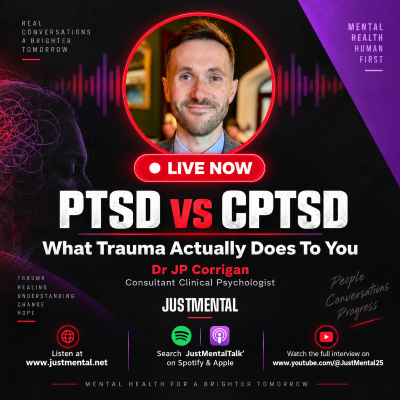
PTSD vs CPTSD: What Trauma Actually Does to You
PTSD vs CPTSD is a distinction that almost never gets explained outside a clinical room, and in Northern Ireland, where trauma runs deeper than most people realise, that gap in public understanding matters.
To unpack it properly, JustMentalTalk sat down with Dr JP Corrigan, Consultant Clinical Psychologist with Belfast Health and Social Care Trust and the Regional Trauma Network. Across a career built around trauma-related mental health, Dr Corrigan has seen first-hand how often these terms get used loosely, and how much that loose usage can get in the way of people getting the right support.
PTSD vs CPTSD: What’s Actually Different?
Both conditions can develop after something overwhelming happens to a person. Someone with PTSD may experience flashbacks, avoid reminders of what happened, and feel constantly on edge, the three symptom clusters that define the condition under international diagnostic guidelines. Complex PTSD (CPTSD) includes all of that, but adds what clinicians call “disturbances in self-organisation”: lasting difficulty regulating emotion, a persistently negative view of oneself, and real difficulty sustaining close relationships. CPTSD typically follows trauma that is prolonged or repeated, and from which escape feels difficult or impossible, sustained abuse, captivity or trafficking, for example, rather than a single traumatic incident.
The distinction is not academic. Treating CPTSD like straightforward PTSD, jumping straight into trauma processing without first building safety and emotional stability, can leave someone feeling worse, not better. Getting the diagnosis right shapes everything that follows.
Why Northern Ireland’s PTSD Rate Is So High
The scale of the problem in Northern Ireland is stark. The Northern Ireland Study of Health and Stress found a lifetime PTSD prevalence of 8.8%, the highest recorded of the 14 countries included in the World Mental Health Surveys, and more than double the global average of around 3.6%. Researchers point to the legacy of the Troubles: well over half of adults in Northern Ireland report experiencing a traumatic event in their lifetime, a substantial proportion of them conflict-related, and the psychological toll of that exposure has persisted for decades after the Good Friday Agreement.
What Real Treatment Looks Like
For PTSD, the National Institute for Health and Care Excellence (NICE) recommends trauma-focused cognitive behavioural therapy (TF-CBT) and eye movement desensitisation and reprocessing (EMDR) as first-line treatments. Complex PTSD usually needs a different approach: a phase-oriented model that establishes safety and emotional stabilisation before any trauma processing begins, reflecting the deeper relational and self-concept difficulties involved.
Dr Corrigan also discusses Intensive Short-Term Dynamic Psychotherapy (ISTDP), an approach he uses in his own practice for problems that feel deeply “engrained”, while being upfront that its evidence base is still emerging rather than settled. That honesty matters: not every promising therapy is a proven one, and knowing the difference is part of making an informed choice about your own care.
The Toll on Healthcare Staff: Moral Injury
Not every psychological wound sustained at work is PTSD. Moral injury describes the distress that follows doing something, or being unable to do something, that violates a person’s own moral or ethical code. It has become an increasingly important lens for understanding the toll on healthcare staff during periods of sustained pressure, including the Covid-19 pandemic. Drawing on his own past experience supporting staff wellbeing in the health service, Dr Corrigan talks through what that toll actually looks like, and what compassion-focused support can do about it.
Finding a Properly Qualified Therapist
If any of this resonates, Dr Corrigan’s advice is to check credentials before committing to treatment. Look for a therapist registered with the British Association for Counselling and Psychotherapy (BACP), the British Association for Behavioural and Cognitive Psychotherapies (BABCP), or a clinical psychologist registered with the Health and Care Professions Council (HCPC). Registration matters because it means a recognised body is holding that practitioner to professional and ethical standards, an important safeguard in a field where anyone can currently call themselves a “therapist” without one.
This PTSD vs CPTSD conversation with Dr JP Corrigan is available now on YouTube, Spotify and Apple Podcasts. If anything in this article has raised something difficult for you, Lifeline NI is there around the clock: 0808 808 8000.