
Social Media Ban for Under-16s: Four Rounds of Parliamentary Ping-Pong, and Children Are Still Waiting
The social media ban under 16 debate returned to the House of Lords http://commonslibrary.parliament.uk today for the fourth time in three months. JustMental has covered this story at every stage, read our previous coverage of the Commons vote in April. Today, the House of Lords returns to a question it has now answered three times and Parliament has still not resolved: should social media platforms be legally required to ban under-16s?
This is the fourth round of what has become an extraordinary piece of parliamentary ping-pong, a back-and-forth between the Lords and the Commons that has produced no ban, no firm deadline, and no binding consequences for the platforms that continue to operate while politicians debate. http://gov.uk/government/consultations/growing-up-in-the-online-world
JustMental has covered every stage of this story. This is where we are now, and why today matters.
The Social Media Ban Under 16: Full Parliamentary Timeline
To understand today’s vote, the full sequence needs to be laid out clearly.
January 2026: Lords vote for a ban: 261 vs 150
During report stage of the Children’s Wellbeing and Schools Bill, Conservative peer Lord Nash tabled an amendment requiring social media platforms to use age-checking technology to prevent under-16s from accessing their services. The amendment was backed by cross-party peers, Conservative, Liberal Democrat and Labour, and passed by 261 votes to 150. The government opposed it.
March 2026: Commons rejects it: 307 vs 173
When the bill returned to the Commons in March, MPs voted to remove the Lords’ amendment. The vote was 307 to 173. The government argued that its consultation, which opened on 2 March, needed to run its course before any firm action was taken. More than 100 Labour MPs abstained.
25 March 2026: Lords back it again: 266 vs 141
The Lords rejected the Commons’ position and reinstated Lord Nash’s amendment, this time by an even larger majority of 266 to 141. The bill went back to the Commons.
15 April 2026: Commons reject it a second time: 256 vs 150
MPs voted again to remove the Lords’ amendment and instead backed government proposals giving the Science Secretary powers to restrict children’s access to social media through secondary legislation.
20 April 2026: Lords back it a third time: 284 vs 158
In their largest majority yet, the Lords backed Lord Nash’s amendment for the third time. The majority had grown with each vote: from 111 in January to 125 in March to 126 in April. Lord Nash described the government’s position as “not a serious proposal.”
22 April 2026: Commons reject it a third time
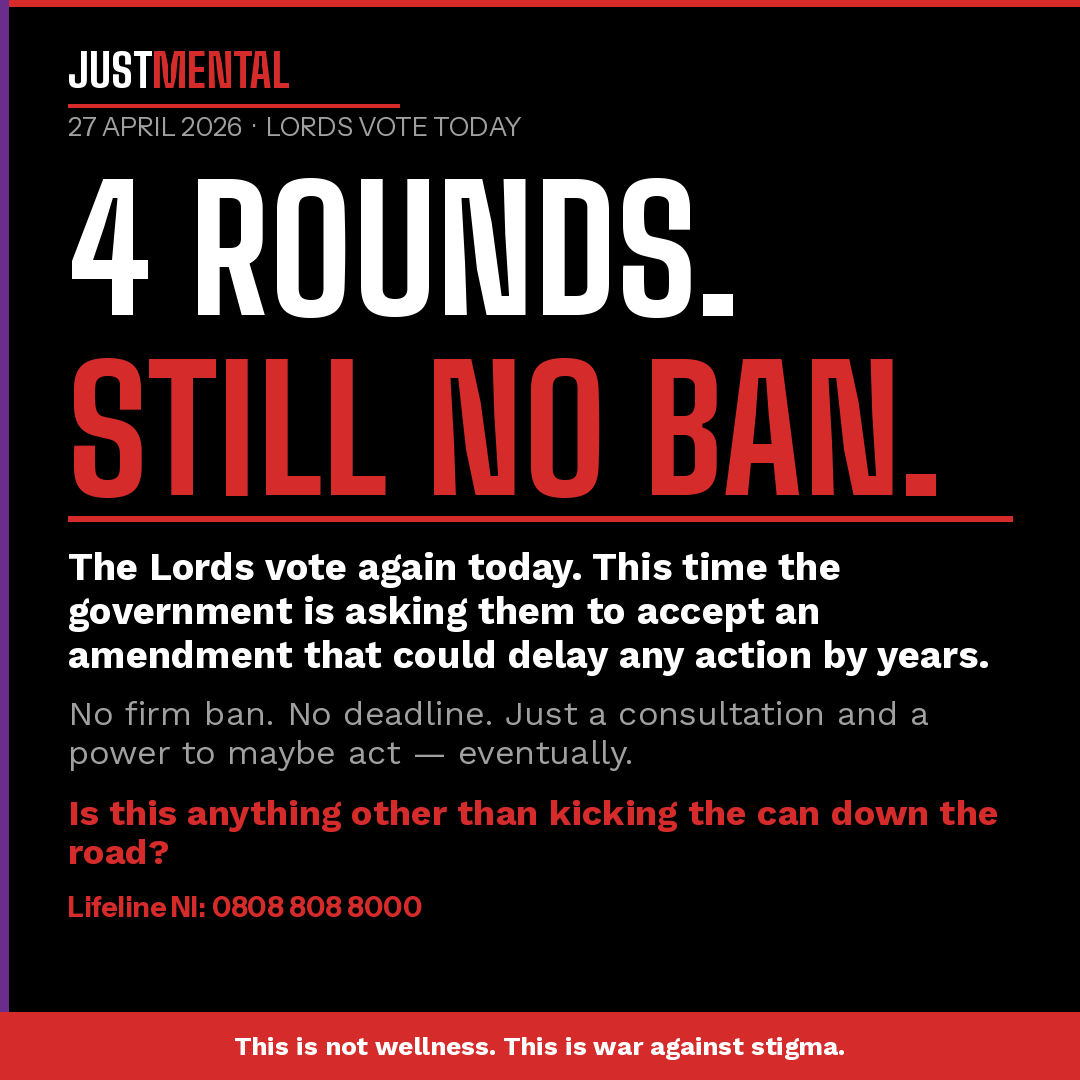
MPs voted down the Lords’ amendment for the third time. The bill now returns to the House of Lords today, 27 April 2026.
What the Government Is Proposing Today
The government is asking the Lords to accept its alternative approach: rather than a legal requirement to ban under-16s, ministers want a power to introduce such a ban through secondary legislation: after the consultation closes on 26 May 2026 and after the government responds ‘by summer 2026’.
The critical difference is the word ‘require’ versus ‘enable.’ Lord Nash’s amendment would require ministers to act within 12 months of the bill passing. The government’s alternative would enable ministers to act: if they choose to, when they choose to, with no enforceable deadline.
Critics of the government’s position: including Lady Kidron, one of the UK’s most prominent online safety advocates: have warned that without Lord Nash’s amendment, ministers could choose not to bring forward any curbs on children’s social media access at all.
Lord Nash: “The platforms will grow more powerful. More children will be harmed, and tragically worse. This is not a serious proposal, and Parliament should not treat it as one.”
Ellen Roome, whose son Jools died during a social media challenge: “This week, Parliament has a final chance to reject this charade.”
What JustMental Is Asking
JustMental does not lobby for a specific parliamentary outcome. What we do is hold the debate to account and ask the questions that the official narrative tends to obscure.
On the basis of today’s vote, there are three questions the government needs to answer publicly and specifically, regardless of how the Lords vote:
- What exactly are social media companies being required to do, not enabled to do, but required? Specific features, specific timelines, specific metrics.
- What is the enforceable deadline for action? ‘By summer 2026’ is not a deadline. A date in legislation is a deadline.
- What are the consequences if the companies do not act? The Online Safety Act allows fines of up to 10% of global annual turnover. Will those powers be used, and at what threshold?
Principles without consequences are not protection. We will continue to ask until we get answers.
The Mental Health Case for Acting Now
Northern Ireland has the highest rate of suicide in the United Kingdom. It has communities where young people are disproportionately exposed to the harms that algorithmic social media platforms are designed, by their own engineers’ admission, to exploit: loneliness, poor self-image, compulsive use, and exposure to content promoting self-harm and disordered eating.
The Molly Russell case established, through a coroner’s inquest, that social media content played a direct role in the death of a 14-year-old. The findings were published years ago. The government is still consulting.
JustMental will continue to cover this story at every stage. If you want to make your voice heard, the government’s consultation is open until 26 May 2026 at gov.uk.
This is not wellness. This is war against stigma.
Lifeline NI: 0808 808 8000 — free, confidential, 24 hours a day.