
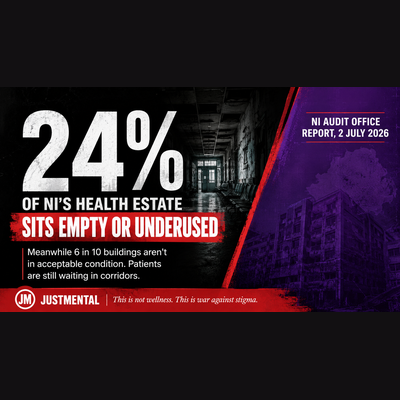
Health Estate NI: 24% Empty or Underused | JustMental
Nearly a Quarter of NI’s Health Estate Sits Empty or Underused. So Why Are Patients Still in Corridors?
This is not wellness. This is war against stigma.
A report published by the Northern Ireland Audit Office on Thursday 2 July 2026, The Health Estate in Northern Ireland, has laid out the true state of the buildings our health and social care system runs on, and the picture is not good.
Here are the verified numbers, straight from the report.
What the Health Estate Report Actually Says
Northern Ireland’s health estate is valued at around £3.7 billion. It covers roughly 1,500 freehold buildings and more than 200 leasehold properties across over 400 sites, hospitals, clinics, day centres, residential accommodation, ambulance and fire stations.
Of that estate:
- 5% is vacant, 91 properties sitting empty
- 19% is underused
- 7% is assessed as overcrowded
That’s 24% of the entire health estate either empty or underused, a serious figure in its own right, and one that needs to be stated accurately rather than rounded up for effect.
Separately, and just as damning: only 40% of the estate is assessed as being in acceptable overall condition. That means six in every ten buildings our health service depends on are not. Just under one-fifth (19%) is assessed as becoming largely untenable for delivering services at all. And 40% is not fully compliant with statutory regulations, requiring upgrade.
Nearly half the estate is more than 50 years old. Around one-sixth is over 75. The maintenance backlog has grown to more than £1.6 billion, with £251 million of that classed as high-risk, the kind of fault that carries real risk of harm: roof and structural defects, electrical and fire safety issues, legionella control. Since 2020-21, around £25 million a year has gone toward tackling it. It hasn’t been enough to stop the backlog growing.
Comptroller and Auditor General Dorinnia Carville was direct about the scale of the problem, describing the estate as “ageing and increasingly not fit for purpose.” Her report found no long-term strategy exists to bring the backlog under control, and recommends the Department of Health and the Trusts set out a clear plan, including a timeframe, for doing so.
Why this matters to JustMental
We’re not going to pretend the Audit Office report is about mental health specifically, it isn’t. It’s about the entire health and social care estate. But the contrast is one our community will recognise instantly.
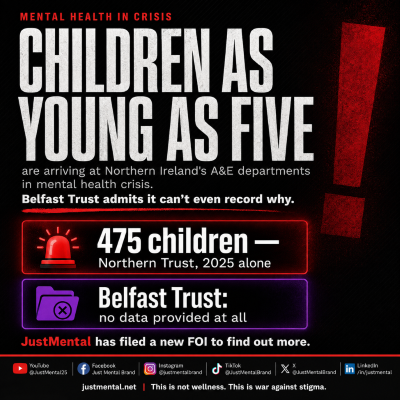
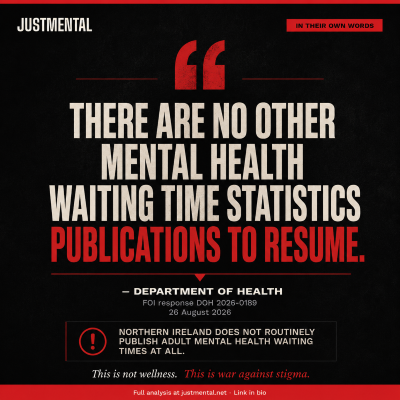
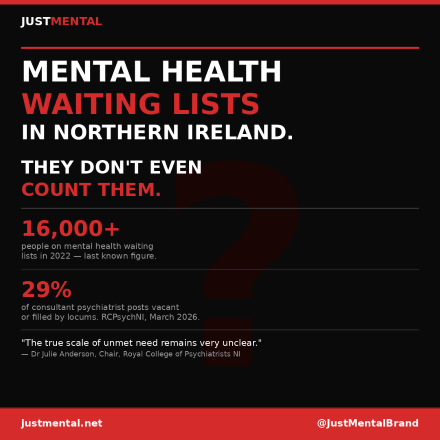
We’re told beds are scarce. We’re told people wait in corridors. We’re told frontline mental health services are stretched past breaking point, over 70% of psychiatrists in Northern Ireland have said they’re considering leaving, and nearly a third of consultant and specialty posts sit vacant. And now we learn that a quarter of the health estate meant to house all of this sits empty or underused, while more than half of what remains isn’t even in acceptable condition.
We’re not going to tell you those underused buildings are simply ready-made crisis units or CAMHS wards waiting for a coat of paint, that’s not what the report says, and pretending otherwise wouldn’t survive five minutes of scrutiny. What we are going to ask, loudly and repeatedly, is this: if the Department of Health is reviewing vacant and underused assets “to ensure more timely and strategic decisions are taken to deliver value for money,” as officials say they are, where does mental health capacity sit in that review? Is it even being asked?
What needs to happen
- A published timeline for the Department of Health’s review of vacant and underused health assets, with mental health capacity explicitly assessed as part of it
- Public confirmation of what proportion of the 91 vacant and underused properties could realistically support crisis, CAMHS, or community mental health services, not vague reassurance, a number
- A costed, time-bound maintenance strategy, as the Auditor General has recommended, rather than another review that goes nowhere
- Transparency from the Executive on how estate decisions connect to the mental health workforce crisis already driving specialists out of the system
We’ll be watching for the Department’s response, and we’ll report back honestly on what does, and doesn’t, follow.
If you or someone you know is struggling, Lifeline NI is free and confidential, 24/7: 0808 808 8000. Samaritans: 116 123.