
The NI schools behaviour review: before the consequence, understand the child
The new NI schools behaviour review, and the appointment of an independent adviser the media have dubbed a “behaviour tsar”, raises important questions we think are worth asking out loud. Education Minister Paul Givan has appointed behaviour expert Tom Bennett to lead a review of behaviour policy and practice across Northern Ireland’s schools, running from summer 2026 to January 2027, when new departmental guidance is due. The intention behind it is one we share: teachers and school leaders are under real pressure, and every child deserves a safe, calm place to learn.
So let us be clear at the outset. We are not against better behaviour support in schools. Staff are stretched, and disruption that goes unaddressed harms the very children it disrupts. Where the review strengthens the hand of exhausted teachers, we welcome it. But as a mental health platform, we have questions, and we are not alone in asking them. Ulster Unionist leader Jon Burrows has already warned that a “behaviour tsar alone won’t fix classrooms”, calling for teachers, school leaders and Northern Ireland’s teacher-training colleges to be brought into shaping the solution.
Why the NI schools behaviour review must start with the ‘why’
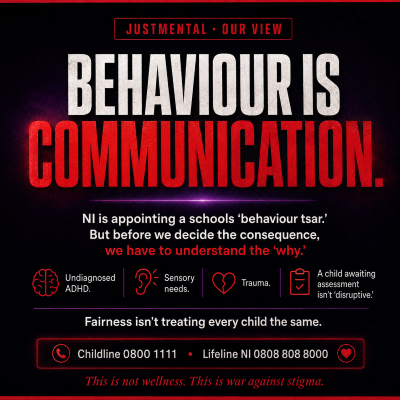
Here is our central point, and it is a clinical one as much as a moral one. Children’s behaviour is communication. Before a school decides the consequence, it has to understand the cause, because the same outward behaviour can have profoundly different roots.
Inattention, fidgeting, lateness, walking out, lashing out, when these are recorded simply as “disruption”, we risk punishing a child for something they cannot yet control or even name. Is that child living with undiagnosed ADHD? Unmet sensory-processing needs? The effects of trauma at home? A child who has been waiting months, sometimes years, for an assessment that Northern Ireland’s overstretched services have not yet delivered? A behaviour policy that cannot tell the difference between defiance and distress will inevitably punish the most vulnerable children hardest, the ones whose needs have not been recognised.
Consistency is not the same as fairness
A “consistent response” sounds unarguable, and in fairness there is a strong case that clear, predictable boundaries help all children, including neurodivergent ones. But consistency must not harden into a rigid, one-size-fits-all rulebook. Fairness has never meant treating every child identically. Fairness means responding to each child according to their actual needs. A blanket sanction applied identically to a child with unmet needs and a child without them is not fair, it just looks tidy on paper.
Which is why the question that matters most is about evidence. What understanding will underpin this new policy? Will it reflect what we now know about child development, neurodiversity and the impact of trauma, or will it lean primarily on compliance and punishment? Tom Bennett’s remit is explicitly to draw on evidence and international best practice, and he has said he wants to hear from staff and students in classrooms from Armagh to Ballycastle. Good. Our ask is simply that the evidence base is the whole evidence base, including the clinical understanding of why children behave as they do.
The people who already do this work
There is a deeper point in the criticism, and we share it. The best behaviour “experts” in Northern Ireland are already in our schools: the teachers, classroom assistants, SENCOs, vice-principals and principals who know these children by name, who spot the child having a hard day, and who defuse a hundred situations a week that never make a policy document. A review that genuinely listens to them, rather than arriving with a fixed answer, could be valuable. One that treats behaviour as a problem to be suppressed rather than a signal to be understood would let down the children who need us most.
We will follow this review closely, and we will judge it by one test: does it help schools understand children better, or just manage them more firmly? Behaviour is communication. The task is to listen before we respond.
If you or a young person you know is struggling, you’re not alone. Childline 0800 1111 · Lifeline NI 0808 808 8000 · Samaritans 116 123 · Text SHOUT to 85258.