
World Bipolar Day 2026: The Number That Should Make Everyone Angry
30th March 2026 World Bipolar Day
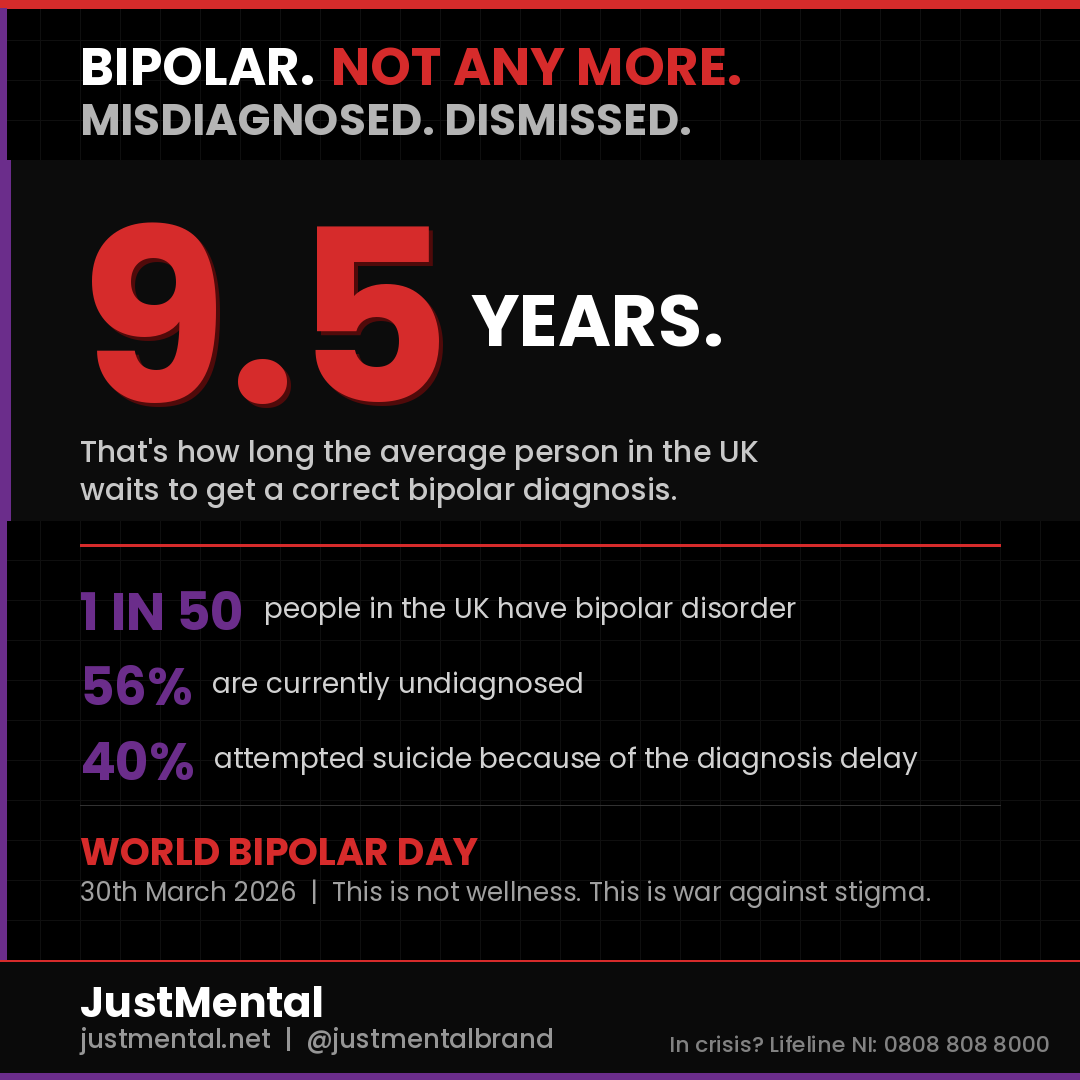
Nine and a half years.
That is the average time a person in the United Kingdom waits between first speaking to a doctor about their symptoms and receiving a correct bipolar diagnosis. Not a few months. Not a year or two. Nine and a half years, during which they are likely to be misdiagnosed, prescribed incorrect medication, and left without any real framework for understanding what is happening to them.
Today is World Bipolar Day, observed every year on 30th March, the birthday of Dutch painter Vincent van Gogh, who was posthumously diagnosed with bipolar disorder. It is a day designed to raise awareness, challenge stigma, and, in an ideal world, apply pressure to the systems that continue to fail people with this condition.
At JustMental, we don’t do wellness platitudes. So let’s be direct about what the data actually says.
The Statistics
According to research published by the Bipolar Commission, a body established by Bipolar UK, and supported by the Royal College of Psychiatrists, the picture in the UK is stark:
- More than 1 million people in the UK are living with bipolar disorder
- 56% of those people are currently undiagnosed
- 70% are initially misdiagnosed, most commonly with depression
- 40% attempted suicide as a direct result of the delay in receiving a correct diagnosis
- People with bipolar disorder die on average 10 to 15 years earlier than the general population, largely due to associated physical health conditions
- The World Health Organisation classifies bipolar disorder as the sixth leading cause of disability worldwide
The Royal College of Psychiatrists and Bipolar UK have publicly called on the Government to halve the 9.5-year average diagnosis delay. That call has been made repeatedly. The average has not halved.
Why the Delay Happens
Bipolar disorder is not straightforward to diagnose. It presents differently across individuals, its symptoms overlap significantly with depression, anxiety, ADHD, and borderline personality disorder, and, crucially, most people only seek help during a low episode. The highs, which can manifest as heightened energy, creativity, reduced need for sleep, and elevated mood, are rarely brought to a GP because they don’t feel like a problem at the time.
In a ten-minute GP appointment, with no blood test or brain scan available to confirm a diagnosis, the picture that emerges is almost always the depression part. Antidepressants are prescribed. For some people with bipolar, antidepressants without a mood stabiliser can actually worsen the condition. The cycle continues. Years pass.
The diagnosis delay is not purely a failure of individual clinicians. It is a systemic failure, of capacity, of training, of time, and of resources within mental health services.
What It Costs
The human cost of a 9.5-year wait is not abstract. The Bipolar Commission’s research found that 40% of people who experienced a diagnosis delay had attempted suicide during that period. More than half had lost a job or left education. Significant numbers reported serious damage to relationships with family and friends.
And because bipolar disorder typically presents first in adolescence or early adulthood, this delay does not just affect a single period of life. It shapes education, career, relationships, the entire trajectory of a person’s development.
World Bipolar Day 2026 Theme: #BipolarStrong
The global theme for World Bipolar Day 2026, led by the International Society for Bipolar Disorders, is #BipolarStrong. In the UK, Bipolar UK is marking the day with a series of free live webinars under the theme ‘Understanding bipolar together.’
JustMental supports this. But we also believe that strength is not just a personal attribute, it is something that should be demanded of the systems that are supposed to support people. Nine and a half years is not strength. It is a failure that we should all be angry about.
If You Are in Northern Ireland
If you are living with bipolar disorder, suspect you might be, or are supporting someone who is, JustMental’s therapist directory at justmental.net/connect lists qualified therapists across Northern Ireland and the Republic of Ireland.
If you are in crisis, contact Lifeline NI on 0808 808 8000. The line is free, confidential, and available 24 hours a day.
The Bottom Line
World Bipolar Day should be a moment of solidarity. It should also be a moment of accountability.
More than a million people in the UK are living with bipolar disorder. More than half of them don’t know it. And those who are seeking answers are waiting, on average, the better part of a decade to receive them.
This is not a niche issue. It is not a fringe experience. It is happening in every town, every street, every community in the country, including here in Northern Ireland.
JustMental will keep saying so until the system changes.
Sources: Bipolar UK Bipolar Commission Report; Royal College of Psychiatrists World Bipolar Day Statement 2024; World Health Organisation Global Burden of Disease; National Centre for Mental Health (NCMH).
In crisis? Lifeline NI: 0808 808 8000