
Northern Ireland Survivor Council: Survivors Leading Change
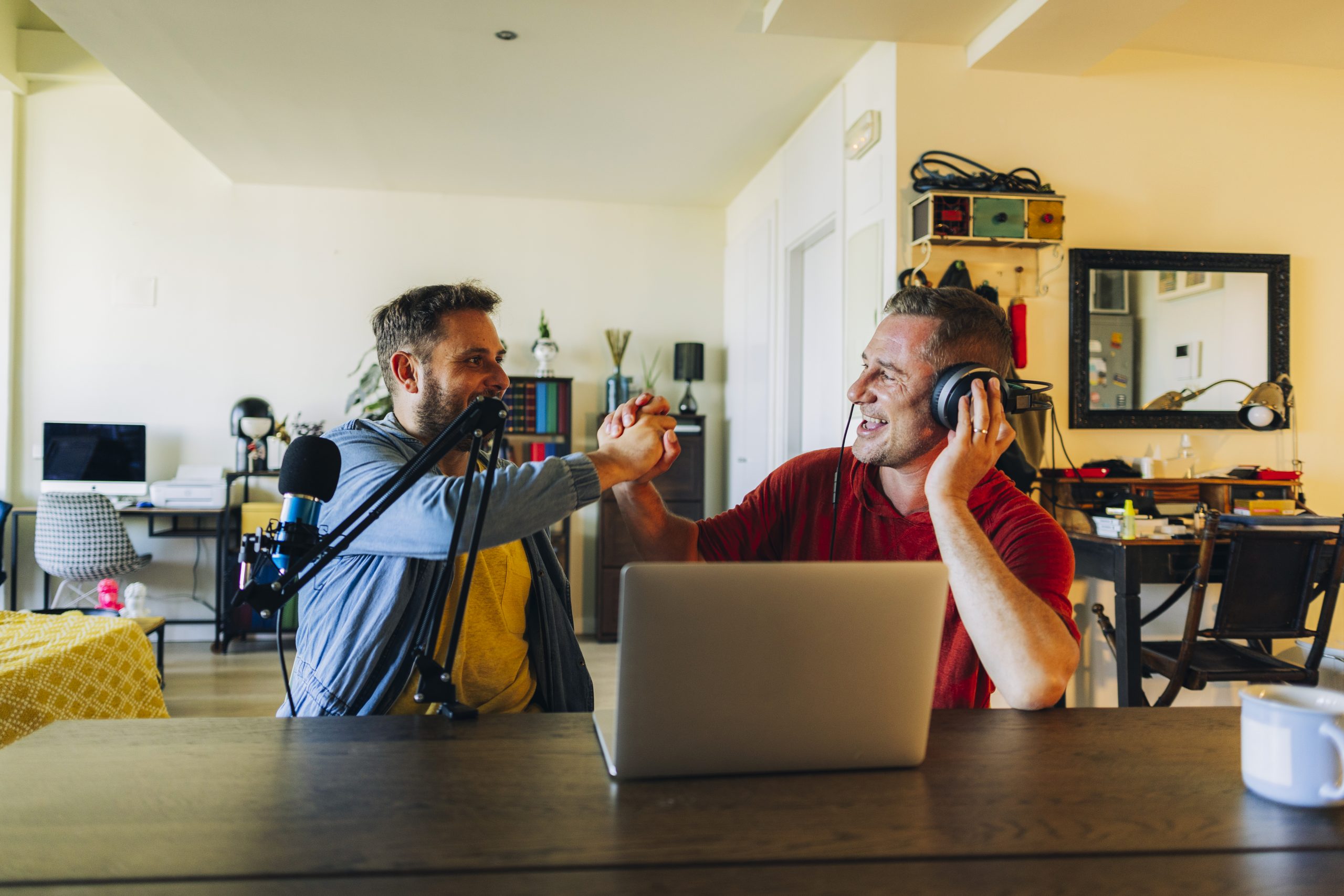
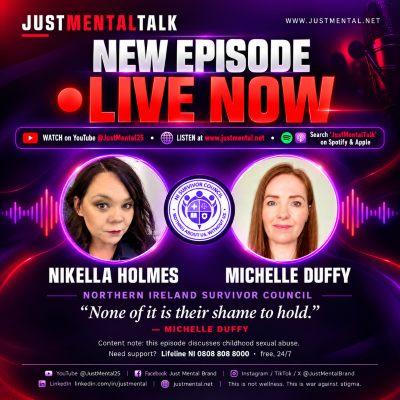
The Northern Ireland Survivor Council is the guest on the latest episode of JustMentalTalk, with founding members Michelle Duffy and Nikella Holmes joining host Karl Bennett for an honest conversation about childhood sexual abuse, the systems survivors say are failing them, and why lived experience should shape the decisions made about their lives. The episode is released on Thursday 8 October 2026 at 4:00pm on YouTube, Spotify and Apple Podcasts.
Content note: this article and the episode discuss childhood sexual abuse. If this is close to home, you don’t have to read or listen alone. Lifeline NI is free and open 24/7 on 0808 808 8000. The Domestic & Sexual Abuse Helpline offers free, confidential support, 24/7, on 0808 802 1414 for anyone aged 18 and over.
Who is the Northern Ireland Survivor Council?
The Northern Ireland Survivor Council is an independent, survivor-led body. Every member is a survivor of childhood sexual abuse, and the Council was set up on the model of the Brave Movement’s national survivor councils. Nikella explained that similar councils already exist in countries including Canada, Germany and Australia.
Michelle described how it came together. A message from the global Brave Movement invited survivor advocates from Northern Ireland to join a worldwide, survivor-led community working to end childhood sexual violence. She travelled to meet other survivors with a fellow advocate, and the group grew from there. Nikella joined later, wanting to use her own story to help other people without doing it alone. They formed the Council a little over a year ago.
The members are volunteers, fitting the work around their full-time jobs. Funding from the Domestic and Sexual Abuse Strategy Small Grants scheme covered one research project, the report, rather than the Council’s wider work.
That report, Nothing About Us, Without Us: Expert Survivor Insights, is dated 30 April 2026. It draws on a survivor-only consultation event in Belfast in February 2026 and an online call for evidence. Michelle explained why organisations and their representatives were not in the room: there is a power imbalance, because many survivors depend on those organisations for support, sometimes the only support they have, and that can make honest feedback harder. The Council’s earlier consultation call-out is also listed on the HSC Engage website.
Why lived experience is expertise
The Council’s tagline, Nothing About Us, Without Us, is the heart of its argument. Nikella told JustMentalTalk that its members are survivors, but also people with degrees, certifications and professional careers, and that they “really believe that lived experience is expertise.” Too many decisions about survivors, she said, are made without them, by people who cannot know how abuse could have been noticed, stopped or healed better.
Michelle drew a clear line between consultation and co-design. At the moment, she said, services, policies and strategies are designed without survivors and then put out for consultation. Her request was simple: “let us be part of leading the systems that affect our lives.”
What the Northern Ireland Survivor Council wants from government
The Council’s central call is to be formally recognised by the Executive Office as an independent body, separate from political influence and routinely consulted on all matters relating to child sexual abuse. That is set out in the report’s recommendations and Call for Action.
Nikella explained why. The concerns of victims and survivors cut across health, justice, education and communities, so no single department owns them. “There is a gap there,” she said.
Recognition, the guests said, would change what the Council can do. It would put survivors at the table when bills, policies and laws are being shaped, rather than after the fact, and it would open the door to funding for more research. Michelle added that it would let the Council recruit properly and become more diverse, because at present it cannot ask more survivors to give their time unpaid.
The report also advocates a public inquiry into clerical abuse in Northern Ireland, citing the number of clerical abuse survivors among those who responded.
Male survivors, grooming and support
The conversation returned several times to male survivors. The report notes that 13% of the survivors who registered interest in the consultation were male, and it recommends targeted recruitment to hear more male voices. Nikella said she did not believe that figure reflects reality. Michelle argued that the question should move from why men are not coming forward to whether they can see themselves represented in services and in the media. Both called for myth-busting aimed specifically at men and boys.
On prevention, Nikella’s single priority was a public campaign explaining what grooming looks like and how it works. “Knowledge is the most important weapon anybody can have,” she said. Michelle pointed out that parents and whole communities are groomed too, and that the online world has widened the risk.
On support, Michelle was direct about the six-to-twelve-session model survivors are often offered. Trauma lives in the body, she said, and with so few sessions “you’re not even scratching the surface.” The report’s findings point the same way, with survivors quoted describing an offer of 12 sessions as nowhere near enough and calling for longer-term, more flexible support.
Asked what she would say to a survivor listening who has never told anyone, Michelle’s message was that none of it is their shame to hold, it is not their fault, and there can be life after childhood sexual abuse.
How to get involved and where to find support
The Council is not a support service, Nikella stressed, but it welcomes contact. Survivors can find the Northern Ireland Survivor Council on Facebook and Instagram, where its Linktree has contact details and a copy of the report, or email nisurvivorcouncil@outlook.com. Survivors who want to be involved in survivor-led, survivor-only events are invited to get in touch. Michelle also pointed out that survivors and allies alike can join the global Brave Movement, which offers safety and healing resources and draft letters for contacting MLAs.
Karl closed the episode with a call to action: if you can, write to your MLA and ask that the Council is formally recognised, and share the conversation with someone who needs to hear it.
If this article has raised anything for you, Lifeline NI (0808 808 8000) is free and open 24/7. The Domestic & Sexual Abuse Helpline (0808 802 1414) is free, confidential and open 24/7 for anyone aged 18 and over. If you or someone else is in immediate danger, call 999.
Watch or listen to the full JustMentalTalk episode with the Northern Ireland Survivor Council on YouTube (@JustMental25), Spotify and Apple Podcasts. Read more in our latest news, or find out more about JustMental.
Why October Mental Health Awareness Matters to Everyone
ADHD, menopause and domestic abuse can look like very different subjects. What they share is that each can affect a person’s mental health, and each is still surrounded by silence, stigma or misunderstanding.
They also reach far beyond the person directly affected. Partners, parents, children, friends and colleagues all feel the impact. All of us have a part to play in noticing when someone is struggling and making it easier to talk. That is what October mental health awareness is really about.
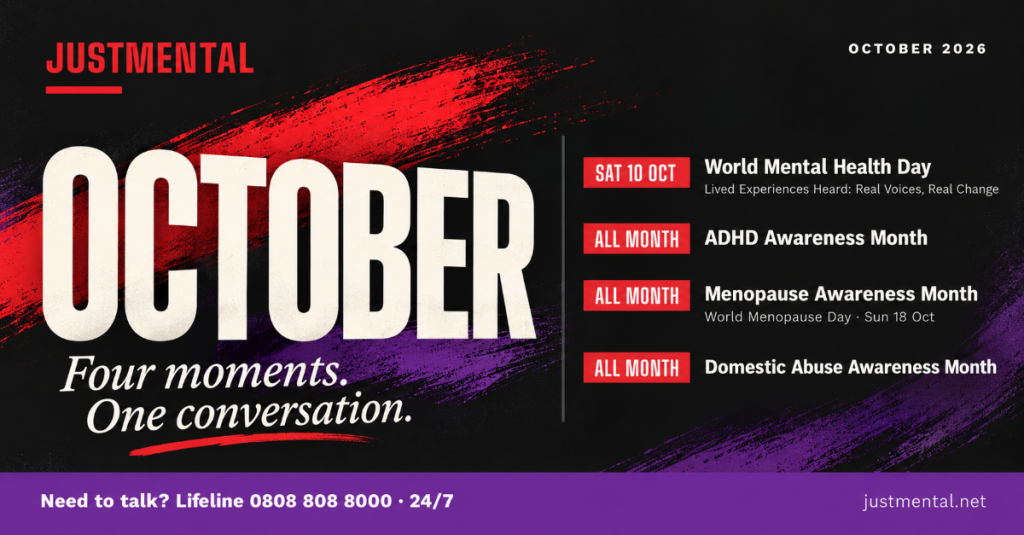
World Mental Health Day: Saturday 10 October
At the centre of October mental health awareness is World Mental Health Day. It was founded in 1992 by the World Federation for Mental Health (WFMH), which sets the theme each year.
The 2026 theme is “Lived Experiences Heard: Real Voices, Real Change”. The WFMH is encouraging organisations around the world to hold events that reflect the theme, while also supporting the World Health Organization’s work on deinstitutionalisation.
The theme sits close to the heart of what we do. JustMentalTalk exists to give people with lived experience the space to be heard, including our conversation with members of the Northern Ireland Survivor Council
ADHD Awareness Month
ADHD Awareness Month runs throughout October. It began as a single ADHD Awareness Day in 2004 and grew into a month as more organisations became involved. What started in North America is now marked by organisations across Europe, including the UK.
ADHD is often thought of as a childhood condition, but many adults seek a diagnosis later in life. For some, that comes after years of struggling with concentration, organisation or their mental health without knowing why.
If you think ADHD may be affecting you or your child, speaking to your GP is the usual first step. The charity ADHD UK also offers information and support.
Menopause Awareness Month and World Menopause Day
October is also widely marked as Menopause Awareness Month, with World Menopause Day on Sunday 18 October. The day was founded by the International Menopause Society (IMS), which chooses a theme every year.
This year’s theme is “Chronic Pain at Midlife”. The IMS says chronic pain affects a significant proportion of women during and after the menopause transition, yet it is still underestimated in both research and care.
There is a clear link to mental health here. IMS President Professor Rossella Nappi has warned that women’s pain has too often been labelled “emotional” rather than properly investigated and treated. Not being believed can take its own toll.
Menopause is not only a conversation for women, and it belongs firmly within October mental health awareness. Partners, families and employers all have a part to play in understanding what is happening and offering support. The IMS has free World Menopause Day resources for women and anyone interested in midlife health.
Domestic Abuse Awareness Month
The UK does not have a nationally recognised Domestic Abuse Awareness Month, but October is widely used by councils, police forces and charities to raise awareness and promote support.
Domestic abuse can happen to anyone, regardless of age, gender or background. It is not always physical. It can also be emotional, financial or sexual, or take the form of controlling and coercive behaviour.
In Northern Ireland, the 24-hour Domestic and Sexual Abuse Helpline is there for anyone affected. Call 0808 802 1414 or email help@dsahelpline.org. Men can also contact the ManKind Initiative on 0808 800 1170.
What’s Coming Up on JustMental This October
Throughout the month, our October mental health awareness coverage will include articles on each of these moments, alongside new episodes of JustMentalTalk.
On Thursday 15 October at 4pm, we release our conversation with Sir Norman Lamb, former Health Minister, NHS trust chair and author of Be More Human: How We Can Fix Our Broken Mental Health Services.
To get every piece as it is published, sign up to The JustMental Insider, our newsletter, which lands every Tuesday.
Where to Find Support
Awareness months can bring up difficult feelings, and October mental health awareness is no exception. If you are struggling, you do not have to wait for an awareness day to reach out.
Lifeline, Northern Ireland’s crisis response helpline, is available 24 hours a day, every day, on 0808 808 8000 (textphone 18001 0808 808 8000). Calls are free for people living in Northern Ireland from UK landlines and mobiles.
If you or someone else is in immediate danger, call 999.
October mental health awareness is a reminder, not a finish line. The conversations that start this month can carry on all year, and we hope you will be part of them.