
Right Care Right Person Northern Ireland: 4 Questions Before 31 October | JustMental
The Right Care Right Person Northern Ireland announcement
The Police Service of Northern Ireland confirmed on UTV News on 2 October 2026 that the Right Care Right Person Northern Ireland implementation will begin on 31 October 2026. Right Care, Right Person is the operational framework under which non-crime mental health incidents are transferred from policing to health service responders. It has already been introduced in England and Wales, where it was intended both to relieve pressure on policing and to ensure that people in acute mental distress are met by a clinically appropriate response.
JustMental has today published this formal statement in response to the Right Care Right Person Northern Ireland announcement, setting out four specific public questions on the operational readiness of the handover. Each question is anchored to a Freedom of Information reference already on the public record.
Where JustMental stands on the model
Right Care, Right Person is a defensible model in principle. The 107a Day Campaign that JustMental launched on 30 June 2026 has argued consistently that policing is not the right response to a person in acute mental health distress, and that the officer time currently being devoted to mental health call-outs is time that should be in the hands of the health service. On that principle, JustMental and the Police Service of Northern Ireland are in agreement.
The question has never been whether Right Care Right Person Northern Ireland is the right model. The question has been whether the receiving health service infrastructure, the operational baseline documentation, and the measurement framework for the handover are in place for safe implementation.
The public record on operational readiness
Between 26 August and 30 September 2026, JustMental received five substantive Freedom of Information responses from the Department of Health and the Police Service of Northern Ireland. A further six Freedom of Information requests are currently on statutory response clocks across all five Health and Social Care Trusts, the Department of Health, and PSNI.
On the record of what has been disclosed so far: the Department of Health confirmed in Freedom of Information response DOH 2026-0189 that routine CAMHS waiting time statistics have been suspended for over 15 months, that no equivalent routine adult mental health publication exists, and that it would not disclose the operational baseline for the Right Care Right Person Northern Ireland implementation. A formal request for internal review of that fifth response remains with the Department.
PSNI confirmed in FOI reference FOI/18565 that it holds no information on the volume of calls currently diverted under the Right Care Right Person framework. These findings sit alongside five years of regulatory warning from the Office for Statistics Regulation in 2021 and the Northern Ireland Audit Office in 2023, both of which identified systemic gaps in Northern Ireland’s mental health data infrastructure.
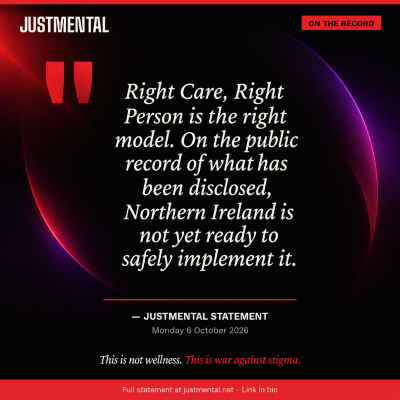
Right Care, Right Person is the right model. On the public record of what the responsible institutions have been willing to disclose, Northern Ireland is not yet ready to safely implement it.
Four questions before 31 October
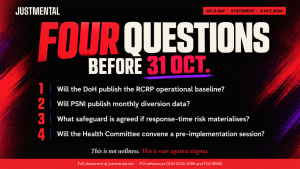
JustMental is today putting four specific operational questions on the public record. Each is anchored in disclosed FOI material, each is reasonable, and each can be answered publicly before 31 October 2026.
- To the Minister of Health: will the Department of Health publish, before 31 October 2026, the operational baseline for Right Care Right Person Northern Ireland implementation that was requested under DOH 2026-0189 and refused, and that remains the subject of the formal internal review currently with the Department?
- To the Chief Constable: will PSNI commit, before 31 October 2026, to publishing month-by-month data on the volume of concern-for-safety calls diverted to health service responders, given that FOI/18565 confirmed in writing that no such information is currently held?
- To the Minister of Health and the Chief Constable jointly: what measurement framework has been agreed to ensure that if ambulance response-time risks of the kind voiced on UTV News by PIPS Charity materialise after 31 October, the operational model is reviewed and if necessary paused?
- To the Chair of the Health Committee: will the Committee convene a scrutiny session with the Minister of Health, PSNI, and the Public Health Agency before 31 October 2026 to publicly test the readiness of the receiving health service infrastructure?
What happens next
Between now and 31 October 2026, six further Freedom of Information responses are due to land across the Department of Health internal review, the PSNI refined request submitted 24 September 2026, and the five Health and Social Care Trusts. JustMental will report publicly on each as it is received.
The four weeks between now and the Right Care Right Person Northern Ireland implementation date are the window in which operational readiness can be confirmed in public, or in which the implementation date should be reviewed. JustMental speaks today in support of the frontline voices already making the clinical-safety case, including PIPS Charity and the Northern Ireland Mental Health Champion Professor Siobhán O’Neill, whose longstanding call for urgent investment in crisis services remains the central context for this entire conversation.
Spokesperson:
Karl Bennett, Co-Founder, JustMental
info@justmental.net | justmental.net
This is not wellness. This is war against stigma.
Crisis support
If reading this has been difficult, or if you or someone you know needs to talk, please reach out. Support is available.
Lifeline (Northern Ireland) · 0808 808 8000 · freephone, 24/7 ·
Samaritans · 116 123 · freephone, 24/7 · [LINK: Samaritans — external]
Childline · 0800 1111 · free, for children and young people ·
SHOUT · Text SHOUT to 85258 · free, 24/7 text support
CALM · 0800 58 58 58 · 5pm to midnight, every day
This is not wellness. This is war against stigma.