
ADHD Awareness Month: 5 Essential Truths About Adult ADHD
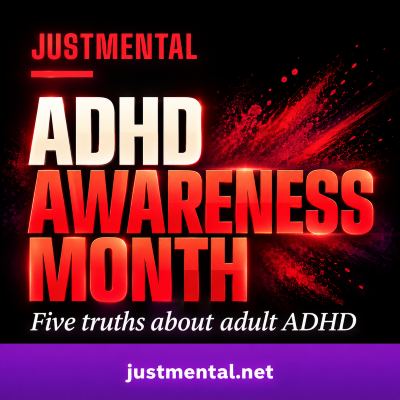
ADHD Awareness Month runs throughout October, and it is a timely reminder that attention deficit hyperactivity disorder (ADHD) is not only something that affects children. Many adults live with ADHD, some without ever knowing it, and it can have a real impact on work, relationships and mental health.
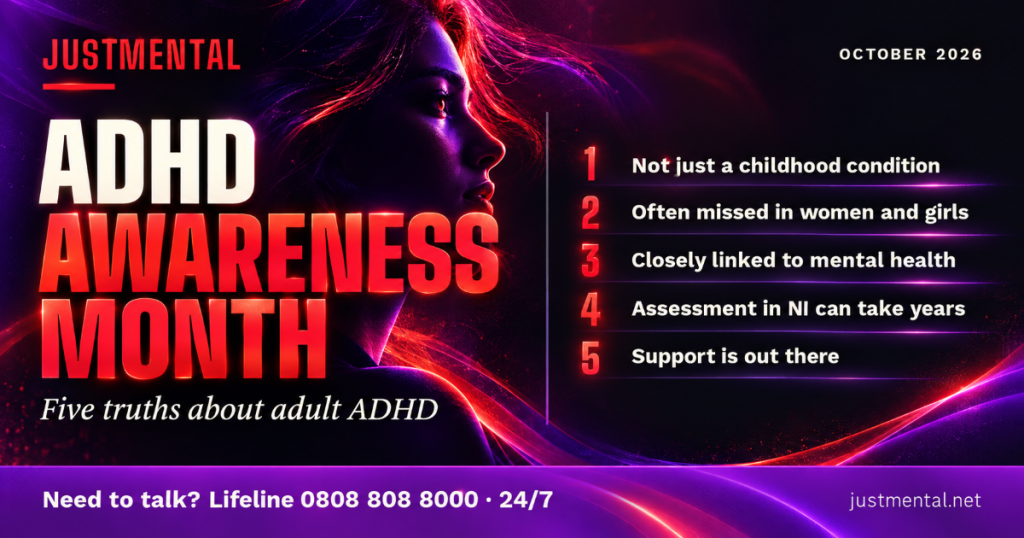
At JustMental, we believe mental health affects all walks of life, and ADHD is no exception. It touches people of every age and background, as well as the partners, parents, children, friends and colleagues around them. Here are five things we think everyone should know this ADHD Awareness Month.
What Is ADHD Awareness Month?
ADHD Awareness Month is led internationally by the ADHD Awareness Month Coalition, made up of the ADHD Coaches Organization, the Attention Deficit Disorder Association and CHADD (Children and Adults with ADHD). Its aim is to share reliable information about ADHD and its treatments.
It began as a single ADHD Awareness Day in 2004 and grew into a month-long campaign as more organisations became involved. What started in North America is now marked by organisations across Europe, including here in the UK.
1. ADHD Is Not Just a Childhood Condition
The NHS says ADHD symptoms usually start before the age of 12, but not everyone is diagnosed as a child. Some people only begin to recognise the signs years later, often after a long time of wondering why everyday things feel so much harder than they seem to for others.
In adults, the NHS describes signs such as being easily distracted or forgetful, often losing things like your wallet, mobile or keys, having a lot of energy or feeling restless, and being very talkative or interrupting conversations. Most people with ADHD have symptoms of both the inattentive and the hyperactive-impulsive type.
Of course, everyone loses their keys now and then. What matters is when these difficulties are persistent and start to affect your studies, your work or your relationships.
2. ADHD Can Look Different in Women and Girls
The NHS notes that ADHD may be recognised less often in women than in men. One reason is that inattentive symptoms, such as distraction and forgetfulness, can be harder to spot than hyperactive ones.
That can mean a woman’s ADHD goes unnoticed for years, with her struggles put down to stress, personality or simply not trying hard enough. One of the most valuable messages of ADHD Awareness Month is that ADHD does not always look the way people expect.
3. ADHD and Mental Health Are Closely Linked
The NHS points out that ADHD often occurs alongside other conditions, including depression, anxiety, addiction and learning difficulties such as dyslexia.
Living with ADHD that has not been recognised can be exhausting. For some people, finally understanding what is going on brings real relief and helps them make sense of years of struggle. That is why awareness matters so much, not just for ADHD itself but for mental health more widely.
4. Getting Assessed in Northern Ireland Can Take Years
In February 2026, the Department of Health published a needs assessment of ADHD services for children, young people and adults in Northern Ireland. It found that there are no existing commissioning arrangements for ADHD-specific services here, and that what is available varies from one health trust to another.
In the Belfast Trust alone, the report found more than 4,000 people waiting for an adult ADHD assessment, with waits of several years. The report made 19 recommendations, including a standardised approach to referral and assessment, and ADHD training for practitioners across health and social care.
The Department has said it is considering those recommendations, and that options for a commissioned ADHD service depend on future budget availability.
5. Support Is Out There
If you think ADHD may be affecting you, speaking to your GP is the usual first step. The NHS advises making an appointment if your symptoms are affecting your studies, work or relationships. Your GP can talk through what support is available and may refer you for a specialist assessment.
Here in Northern Ireland, ADD-NI provides specialist support for children, young people and families affected by ADHD, including parenting programmes, counselling and a telephone support service for parents. You can call them on 028 9081 2222.
Across the UK, ADHD UK offers information, resources and free online support groups.
This ADHD Awareness Month, ADHD UK is also running its Active4ADHDUK challenge, inviting people to be active for 31 minutes a day for 31 days, in whatever way suits them, from walking and swimming to yoga or meditation, while raising funds for the charity. You can start on any day in October.
How to Support Someone With ADHD
You do not need to be an expert to make a difference. A few small things can help someone with ADHD feel understood:
- Ask what helps, rather than assuming. ADHD affects everyone differently.
- Be patient with lateness, forgetfulness or lost focus, and try not to take it personally.
- Avoid jokes like “we’re all a bit ADHD”, which can make real struggles feel trivial.
- Encourage them to talk to their GP if they are worried, and offer to go along if that would help.
- Notice their strengths and successes, not just the struggles.
Where to Find Support Right Now
You do not have to wait for an assessment, or for ADHD Awareness Month, to reach out if you are struggling.
Lifeline, Northern Ireland’s crisis response helpline, is available 24 hours a day, every day, on 0808 808 8000 (textphone 18001 0808 808 8000). Calls are free for people living in Northern Ireland from UK landlines and mobiles.
If you or someone else is in immediate danger, call 999.
To see what else is happening this month, read our October mental health awareness guide
ADHD Awareness Month is a chance to swap stigma for understanding. Whether you have ADHD, think you might, or love someone who does, you are not alone, and the conversation does not have to end when October does.