
Child sexual abuse mental health: NSPCC’s 1 in 20 figure
Around 1 in 20: NSPCC research on the child sexual abuse mental health impact
NSPCC research finds around 1 in 20 children in the UK have been sexually abused. JustMental on what that figure means, and where survivors and concerned adults can turn.
By Karl Bennett, JustMental
Content note: this article discusses childhood sexual abuse and its long-term mental health impact. No graphic detail and no specific case examples. Support contacts at the foot of the piece, separated by who they are for. You do not need to be in crisis to call any of them.
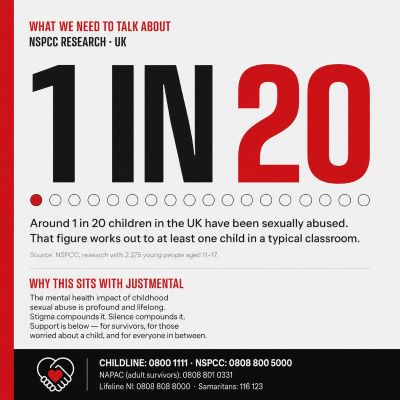
Around 1 in 20 children in the UK have been sexually abused. That is the headline figure from NSPCC research, and it is the figure that sits at the centre of any honest conversation about child sexual abuse mental health in this country.
JustMental does not run campaigns on this issue. We are not a safeguarding organisation, a survivors’ service, or a children’s charity. But the child sexual abuse mental health impact is profound and lifelong, and a platform built explicitly to push against mental health stigma cannot stay silent on it. This piece is acknowledgement, not editorial advocacy. The advocacy is being done, and being done well, by the organisations whose contacts are at the foot of this article.
Where the 1 in 20 figure comes from
The 1 in 20 figure is drawn from NSPCC research with 2,275 young people aged 11 to 17, surveying them directly about their experiences. Around 4.8% of respondents reported contact sexual abuse, roughly 1 in 20.
The same research found that 7.0% of girls and 2.6% of boys reported experiencing contact sexual abuse. The figure including non-contact forms of sexual abuse is significantly higher, around 16.5% of 11- to 17-year-olds. The 1 in 20 figure is the more conservative estimate, drawn from the most direct definition of abuse.
The research was originally published by NSPCC and remains the most cited current UK figure on the subject.
What the figure means in real terms
The average UK class size is between 27 and 30 pupils. At a rate of around 1 in 20, that works out to at least one child, sometimes two, in every classroom in the country.
That is a hard sentence to read. It should be.
The child sexual abuse mental health impact
The evidence base on the child sexual abuse mental health impact is extensive, decades deep, and consistent in its findings. Survivors of childhood sexual abuse are at significantly elevated risk for a range of long-term mental health difficulties:
- Depression, often persistent across the lifespan.
- Post-traumatic stress disorder.
- Anxiety disorders.
- Substance use issues.
- Suicidal ideation and self-harm.
- Difficulties with attachment, relationships, and trust.
- Eating disorders.
This is not exhaustive. It is also not deterministic. Many survivors live full lives, build relationships, do work they love, and find paths to recovery. But the population-level data is unambiguous: childhood sexual abuse is one of the single largest contributors to long-term mental health difficulty that any public health system tracks.
The child sexual abuse mental health connection is not a fringe concern of safeguarding services. It is a core driver of the adult mental health caseload across the UK and Northern Ireland, and one that often goes undisclosed for decades, because survivors learn very early that disclosure is unsafe.
Why silence makes the child sexual abuse mental health impact worse
Two reasons.
The first is internal. Survivors who do not feel able to name what happened to them often carry it alone, sometimes for the whole of their lives. The mental health cost of that carrying is enormous and well-documented.
The second is structural. When the public conversation about child sexual abuse is conducted in whispers, when it is treated as a topic too uncomfortable to address openly, survivors learn that society would prefer they remain silent. That silence is not protective. It is a continuation of the original isolation.
A platform whose tagline is “war against stigma” cannot consistently push against stigma in every other mental health domain while staying quiet on this one.
For survivors
If you are a survivor of childhood sexual abuse and reading this:
- You are not alone. Around 1 in 20 children in the UK have been through some version of what you have been through. Many of them are also still carrying it.
- The child sexual abuse mental health impact you may be feeling, whether it surfaced years ago or only recently, is not a personal failing. It is one of the most documented and predictable consequences of what was done to you.
- Support specifically for adult survivors of childhood sexual abuse exists in the UK and is confidential.
Support routes for adult survivors:
NAPAC: 0808 801 0331 (the National Association for People Abused in Childhood).
The Survivors Trust: 08088 010 818.
Lifeline NI: 0808 808 8000 (free, confidential, 24/7).
Samaritans: 116 123 (free, 24/7).
For adults worried about a child
If you are reading this because you are worried about a child:
NSPCC Helpline: 0808 800 5000 — for any adult concerned about a child’s safety.
Childline: 0800 1111 — if you want to tell the child where they themselves can get support.
Your local police service can be contacted on 101 (non-emergency) or 999 (emergency).
A final note
If you have read this far and something has surfaced for you, the support above is real and confidential. You do not need to be in crisis to call.
This is not wellness. This is war against stigma.