
Tell Us Once: Why People with Mental Health Problems Shouldn’t Have to Repeat Themselves
A landmark report published last month calls for a ‘Share Once’ data sharing system so people with mental health conditions can disclose their needs to essential services without having to start from scratch every single time. The government had plans. Those plans stalled. JustMental thinks it’s time to say that plainly.
The Problem Nobody Should Have to Explain Twice
Picture this. You have a mental health condition, depression, anxiety, bipolar disorder, PTSD, or any of the many diagnoses that affect millions of people across the UK. Your condition affects how you communicate, how you manage finances, how you deal with bureaucracy and pressure.
You need to contact your energy provider about a payment plan. You explain your situation. You get through it. A week later you ring your bank about a direct debit. You explain your situation again. Then it’s Universal Credit. Then your landlord. Then your telecoms company.
Every time, from scratch. Every time to someone who may or may not know what to do with that information. Every time in the hope that this disclosure, this moment of telling a stranger something deeply personal about your mental health, will result in the support or flexibility you actually need.
This is the reality for people with mental health conditions navigating essential services in the UK in 2026. And a landmark report published last month by the Money and Mental Health Policy Institute has put it in writing, with evidence, with data, and with a clear demand for the government to act.
The report is called Stuck on Repeat. It is worth your time.
What the Report Actually Says
The Money and Mental Health Policy Institute is one of the UK’s leading mental health research organisations. Founded by Martin Lewis, yes, that Martin Lewis, it focuses specifically on the intersection between financial difficulty and mental health, a relationship that is far more common and far more serious than most public conversation acknowledges.
Stuck on Repeat calls for a ‘Share Once’ system: a mechanism through which a person can disclose their mental health needs and support requirements to multiple essential services providers through a single, secure, consent-driven process. One disclosure. Multiple services informed. No repetition required.
The principles the report sets out for how this should work are worth knowing in full:
Informed and dynamic consent, the person sharing their data must be able to give, revisit, and withdraw consent at any point, with full confidence that this will be respected.
Control and choice, individuals decide what is shared, with whom, and when. Not the system. Not the provider. The person.
Transparency at every step, clear, accessible information about what data is being shared, why, and with which organisations.
Ethical and proportionate use, only the data that is necessary, used only for agreed purposes, with clear and demonstrable benefits to the person.
Strong safeguards and accountability, robust security, clear rules, and real consequences for misuse. Not promises. Consequences.
Inclusive design, the system must be built with and for people with lived experience of mental health conditions, so it actually works for the people who need it most.
“I think if the principles were in place, by the right people, then I think there’s huge potential for this to be life changing for a lot of people.”
That is a direct quote from a member of the Money and Mental Health Research Community, a group of 5,000 people with lived experience of mental health problems or of caring for someone with them. It sums up the report’s central finding: the potential here is significant. The conditions for realising it need to be right.
The Statistic That Should Stop You in Your Tracks
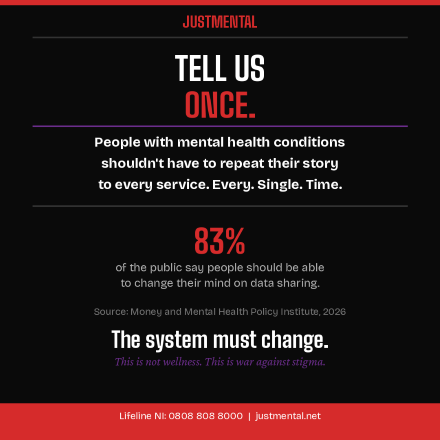
Eighty-three per cent of the public agree that people should be able to change their mind on whether their information is being shared.
Eighty-three per cent. That is not a fringe view. That is not a campaign position. That is virtually the entire country agreeing on a basic principle of data ethics and personal dignity.
And yet the system that would allow someone to share their mental health needs once, safely, and have that respected across services does not exist. Instead, people repeat themselves. People avoid disclosing because the process of disclosure is itself exhausting and demeaning. People fall through the gaps because the services that could support them never knew they needed support.
That is not a technology problem. That is a political will problem.
The Plans That Stalled, and Why That Matters
This is where it becomes particularly frustrating. Before the 2024 general election, there was actual momentum on cross-sector data sharing in the UK. The previous government had set out plans for a ‘Share Once Support Register’ that would have brought the telecoms sector into an existing framework already used by energy and water companies.
Those plans stalled after the election. The new government has not restarted them.
The Money and Mental Health Policy Institute’s report is a direct call to change that. It asks the government to work with regulators, industry, consumer organisations, and people with lived experience to make this system a reality. Not eventually. As a priority.
JustMental supports that call. Completely.
Why This Hits Harder in Northern Ireland
Northern Ireland carries a heavier mental health burden than anywhere else in the UK. One in five adults here shows signs of a mental health problem. Rates of PTSD are among the highest in the world, the direct legacy of thirty years of conflict. Waiting lists for mental health services are some of the longest in these islands. And austerity has hit our communities, particularly our working-class communities, harder than most.
The people who most need essential services to work with them, not against them, are often the people least equipped to fight for that accommodation every single time they pick up the phone.
A ‘Share Once’ system would not solve the Northern Ireland mental health crisis. Nothing so modest could. But it would remove one of the many grinding, unnecessary obstacles that make navigating services with a mental health condition so much harder than it needs to be.
That matters. Even that much matters.
What Needs to Happen Now
The report makes several concrete recommendations. At JustMental, what we are watching for is simple: does the government restart the work on the Share Once Support Register, or does it stay stalled?
Because this is not a complicated ask. The principles are agreed. The public support is overwhelming. The evidence of need is clear. What is missing is political will to treat the daily indignities faced by people with mental health conditions as something that deserves urgent government attention.
JustMental was built on the belief that mental health is a systemic issue, not an individual failing. Reports like Stuck on Repeat matter because they take that argument out of the realm of opinion and put it into the realm of evidence. They give people, all of us, something concrete to point to when we say the system is failing.
The system is failing. The report says so. Now someone needs to fix it.
Read the full report Stuck on Repeat at the Money and Mental Health Policy Institute website.
This is not wellness. This is war against stigma.
JustMental, a Northern Ireland-based mental health advocacy platform launched in November 2025. JustMental produces the weekly podcast JustMentalTalk and the clothing line JustMentalWear, with JustMentalConnect, a therapist directory for Northern Ireland and beyond, in development.
If you or someone you know is struggling: Lifeline NI — 0808 808 8000. Free. Confidential. Available 24 hours a day.