
Childline and the NSPCC Helpline Explained | JustMentalTalk
Childline and the NSPCC Helpline: Our JustMentalTalk Conversation
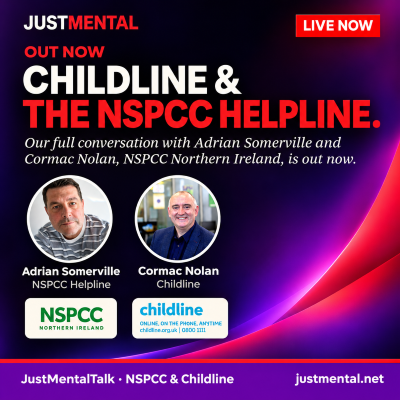
Childline and the NSPCC Helpline don’t always get credit for just how much ground they cover, so when Adrian Somerville (NSPCC Helpline) and Cormac Nolan (Childline) joined JustMentalTalk, recorded just over a week after the death of Childline’s founder, Dame Esther Rantzen, we wanted to let them explain it properly, in plain terms, from the people who actually answer the phone.
The difference between Childline and the NSPCC Helpline
Childline is one of the services run by the NSPCC, built around children and young people up to the age of 19 (with occasional flexibility either side). The NSPCC Helpline, by contrast, is there mainly for adults with a welfare concern about a child, though a young person who does contact it is never simply turned away. Confidentiality works differently too: Childline deliberately sets its threshold higher than the Helpline’s, to give children the confidence to open up, with limits only where there’s a real safeguarding risk. Adults contacting the Helpline can choose to stay anonymous, share their details privately with NSPCC staff only, or consent to those details being passed to other agencies.
What’s actually coming through the phone lines
Across both Childline and the NSPCC Helpline, Adrian and Cormac described a more tangled picture than one single trend: a rise in online-related harm such as sexually motivated blackmail (“sextortion”), a sustained increase in domestic abuse being reported, and a long-running rise in children and young people reaching out specifically about diagnosed and diagnosable mental health difficulties, often alongside loneliness, identity, and the pressures of school and social media. Both were careful to say this reflects people becoming more willing to talk about these issues, not necessarily that life is getting harder across the board. It also rarely comes as one issue in isolation; neglect, for example, is almost always a symptom of something else going on in a household.
Yes, adults can call, even about something that happened to them
One of the clearest messages from the episode: an adult with a nagging concern about a child, a neighbour, a grandparent, a teacher, should still ring the NSPCC Helpline, even without proof. The conversation itself is free and confidential, and will help work out what, if anything, needs to happen next. The Helpline isn’t only for concerns about other people’s children, either: Adrian confirmed that adults who experienced abuse themselves as children, including non-recent abuse, can and do call for support, and that staff will also sensitively check whether there’s any ongoing risk linked to their situation, such as whether the person responsible still has contact with children, without that getting in the way of the support being offered.
Signs worth paying attention to
Cormac described some of the top-line signs to watch for in a child or young person: becoming more withdrawn, unexplained changes in mood, money appearing that can’t be accounted for, or new friendships that feel out of character. None of these prove anything on their own, and sometimes there’s no visible sign at all, but the advice from both guests was consistent: if something doesn’t feel right, it’s worth saying so or asking the question, rather than staying quiet.
How to actually get in touch
Here’s exactly how to reach Childline and the NSPCC Helpline, whoever you are and whatever you need to talk about:
- Children and young people: call Childline free on 0800 1111, any time, day or night, or chat, email and find self-help tools through a free account at childline.org.uk
- Adults with a concern about a child: call the NSPCC Helpline on 0808 800 5000 (10am–4pm, Monday to Friday), or email help@nspcc.org.uk (11am–4pm, seven days a week)
- Both services also offer British Sign Language video and interpreter support for people whose first language isn’t English
- Adult survivors of past abuse: the NSPCC Helpline is there for you too, on the same number
Remembering Dame Esther Rantzen
Childline is part of something much bigger than one helpline. Child Helpline International now counts more than 150 member helplines across over 130 countries and territories, a network that traces back to the service Rantzen built from just 30 phone lines in 1986. That reach was on our minds throughout this recording, made just over a week after her death on 30 September 2026.
If there’s one thing to take from this conversation, it’s that neither service is only for the worst-case scenario. Whether you’re a child who needs someone to listen, an adult with a nagging feeling about someone else’s child, or an adult still carrying something from your own childhood, both Childline and the NSPCC Helpline exist for exactly that call. Watch or listen to the full conversation with Adrian Somerville and Cormac Nolan below.
|
If you’re a child or young person and need to talk to someone, Childline is free and confidential on 0800 1111, or at childline.org.uk. If you’re an adult worried about a child, or an adult survivor of abuse yourself, the NSPCC Helpline is there on 0808 800 5000. In Northern Ireland, Lifeline is free and available 24/7 on 0808 808 8000. Anywhere in the UK or Ireland, Samaritans are free on 116 123. In an emergency, call 999. |