
Niall and Mairead Heron: Honest Talk on Mindfulness
Niall and Mairead Heron: Mindfulness, Mental Health and Learning to Be Kinder to Yourself
Content note: this article and the episode it covers discuss suicidal thoughts, addiction and postnatal depression. Support details are at the end. |
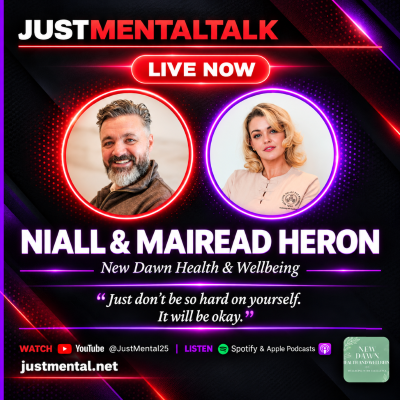
Niall and Mairead Heron run New Dawn Health and Wellbeing in Cookstown, County Tyrone, a husband-and-wife practice built on a simple idea: mental health support works best when it looks after the whole person. On this week’s JustMentalTalk, they sit down with host Karl Bennett to explain how New Dawn began, why they moved beyond a standard counselling model, and what their own experiences of panic attacks, addiction and postnatal depression have taught them.
How New Dawn Health and Wellbeing began
Niall had been working as a counsellor for a good number of years when he met Mairead, and the two found they shared the same instinct. The medical model and its tried-and-tested treatment plans had worked for some of the people they saw, but for many it hadn’t. During COVID, they decided the basic counselling model wasn’t working well for them or for many people, so they set out to diversify and rebrand as something new and bespoke. The result was New Dawn Health and Wellbeing.
As Niall jokes, every good venture has a marvellous woman pushing it forward, and in this case that is Mairead, whom he calls the real heart behind it all.
What holistic mental health care looks like in practice
For Niall and Mairead, holistic mental health care means meeting each person where they are and looking at the mental, emotional, physical and social sides of their life together. Counselling still has its place, and they still use those skills, but they also bring in mindfulness, Tai Chi and Qi Gong, nature walks and cold water therapy. Qi Gong, Niall explains, is the more accessible of the two: a three to five minute practice in the morning can get the body moving and help you drop out of your head and into your body.
They say they are walking the walk as well as talking the talk, trying these practices themselves before offering them to others. They also go into schools to teach mindfulness to children, and they would like to see it become part of the curriculum from primary three upwards, rather than a six or eight week programme.
Niall’s story: panic attacks, ADHD traits and finding a purpose
Niall traces his first panic attack to a primary seven nativity play. He can’t remember what was going through his mind, only what it felt like in his body, and he says that fear of the spotlight shaped years of avoiding public speaking and stepping forward. He also describes ADHD and autistic traits that nobody around him had the language for at the time, and the trouble, low self-esteem and bullying that followed, along with drinking to quieten a very busy mind.
The end of the 1990s brought both joy and loss: the birth of his son in 1999 and, a few months later, the death of his father. Niall talks about the grief, isolation and substance use that followed, and about how dark that period became. What helped was being listened to without judgement by a priest who offered pastoral care without preaching, returning to counselling, and having his son as an anchor and a reason to be a better role model. In his mid-twenties he trained as a counsellor, because he knew he wanted a life with purpose, supporting other people.
Mairead’s story: postnatal depression and the gap between kind and helpful
Mairead’s difficulties began after the birth of her children. She was 24, felt cut off from herself and overwhelmed, and told everyone she was fine. It was her health visitor who spotted the signs and asked whether she was really okay, a moment Mairead describes as the floodgates opening. The NHS says postnatal depression symptoms can begin up to a year after a baby is born, and that fathers and partners can also experience depression after having a baby.
She also felt alone, even though people were kind and sent messages. The Herons’ answer is that noticing someone is struggling is not the same as doing something about it: compassion, as they see it, is the action that follows the noticing. Mairead also talks about her decision to stop breastfeeding so that she could take the antidepressants she had been prescribed. She says fear and a lack of information shaped that decision, and that she regrets losing that bonding experience. That is her personal experience, not medical advice. Anyone worried about medication and breastfeeding should speak to their GP, midwife or health visitor.
The turning point was mother and baby groups. After a few weeks she realised other mothers were going through the same thing, and her confidence began to return. A childcare place made it possible for her to attend, and she went on to the Moving On programme for young mothers, gained qualifications, returned to university and spoke about her experience in maternity wards to help other mothers.
Compassion, self-compassion and the “ritual buffet”
Niall and Mairead Heron both talk about the people who guided them: a priest for Niall, a health visitor for Mairead. They hope to be that kind of guide for the people who come to New Dawn, someone who listens without judgement and without trying to fix everything.
They describe self-compassion as having three parts: kindness towards yourself, mindfulness, and common humanity, the recognition that everyone hurts in some way and that you are not alone. And they are clear there is no silver bullet. Niall describes a “ritual buffet” of small habits, from hot water and lemon in the morning to an evening walk, and encourages people to pick what might lift their mood today, keep trying, and build up a combination that works for them.
Isolation, connection and what men’s and women’s mental health have in common
Asked what men’s mental health and maternal mental health share, the answer is isolation. Niall and Mairead say many people feel disconnected even in an always-online world, and that a lost sense of purpose and a constant stream of unhelpful online content add to the strain. Their retreats begin with everyone sitting in a circle, and they say that simple act of being present together is where connection starts. They also say they are seeing more men coming along to their groups.
Where to find New Dawn Health and Wellbeing
New Dawn Health and Wellbeing is based in Cookstown. To find out more about the work of Niall and Mairead Heron, including their groups and events, visit the New Dawn Health and Wellbeing website.
The message from Niall and Mairead Heron: be kinder to yourself
Asked for one piece of advice for anyone who recognises themselves in their stories, their answer is simple: “Just don’t be so hard on yourself. It will be okay.” They add that you might need help, and that it is okay to ask for it. It is a fitting note to end on, and one that runs through the whole conversation.
Support if you need it
If this article or the episode has brought anything up for you, you are not alone. Lifeline is a free, 24-hour crisis helpline in Northern Ireland: 0808 808 8000. Samaritans is free to call at any time on 116 123. Your GP can also help. Read more about postnatal depression on the NHS website.
Watch and listen to JustMentalTalk
Watch the full conversation with Niall and Mairead Heron on YouTube at @JustMental25, or listen on Spotify and Apple Podcasts. Browse more episodes on the JustMentalTalk or head to the JustMental homepage.