
Lords Defeat Government on Social Media Ban — For the Second Time
The Lords Have Done It Again, And This Time the Government Admitted the Ban Is Coming
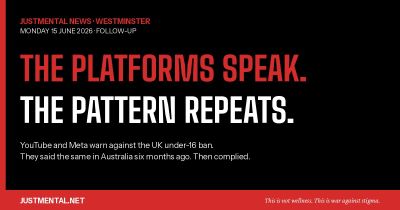
The House of Lords has voted for the second time to back a ban on social media for children under 16 in the United Kingdom, and this time, the government’s own Technology Minister acknowledged in the chamber that action is no longer a matter of whether, but of how.
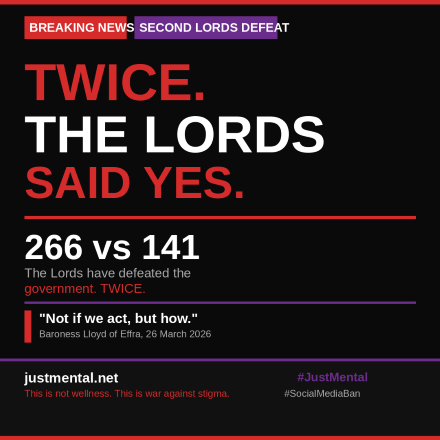
Peers voted 266 to 141 in favour of the amendment brought by Conservative former minister Lord Nash to the Children’s Wellbeing and Schools Bill. That is a larger majority than the first Lords vote in January, when peers backed the same amendment 261 to 150. Far from losing momentum, the push to protect children from social media harm in the upper chamber has grown stronger.
This is the second government defeat on this specific issue. The bill now returns to the House of Commons, where ministers must once again decide how to respond to a House of Lords that is demonstrably not backing down.
What the Amendment Would Do
Lord Nash’s amendment is specific and time-limited. It would require the government to decide, within 12 months, which social media platforms should be unavailable to under-16s. Those platforms would then be required to introduce highly effective age verification measures.
During today’s debate, Technology Minister Baroness Lloyd of Effra made a statement that concedes the principle at the heart of this campaign:
“It is not if we act, but how.”
That is the government acknowledging that the status quo is no longer defensible, and that intervention will come. The remaining question is what form it takes and how quickly Parliament delivers it.
The Legislative Background
The Children’s Wellbeing and Schools Bill has been the focus of intense political dispute for months. The Lords first voted to include Lord Nash’s amendment in January 2026, with 261 peers supporting it against 150. When the bill returned to the House of Commons in March, MPs voted 307 to 173 to remove the amendment, but the government was forced to offer concessions, accepting powers to impose age restrictions and ban specific platform features through secondary legislation, without requiring an entirely new act of Parliament.
The bill returned to the Lords on 25 March 2026 for peers to consider those Commons concessions. Today’s second defeat signals clearly that peers do not consider those concessions sufficient. The bill must return to the Commons for another round of ping-pong. The government’s room for manoeuvre is narrowing with each exchange.
Why This Is a Mental Health Emergency
At JustMental, we have consistently argued that what is happening in Westminster on this issue is not a technology policy debate. It is a mental health emergency, one that has been building for years and has been inadequately addressed by successive governments and regulators.
The evidence base is extensive and is not seriously contested. Heavy social media use in children and young people is linked to significantly elevated rates of anxiety, depression, self-harm, eating disorders and disrupted sleep. Children are spending hours daily on platforms that are not passively neutral but are actively engineered to maximise the time users spend on them. Algorithms serve content that provokes emotional responses, and the content most effective at provoking those responses is, disproportionately, the content most harmful to vulnerable young people.
This week, a jury in Los Angeles found that Google and Meta deliberately built their platforms to hook young users without adequate regard for the mental health consequences. That is not an allegation. It is now part of the legal record.
The Lords who voted today, and in January, understand what is at stake. Peers during the January debate described what is happening to children as ‘nothing short of a societal catastrophe.’ That language reflects the daily reality of clinicians, parents, teachers and young people living with the consequences of unregulated algorithmic harm.
What Needs to Happen Now
A minimum age for social media access is a necessary first step, but only a first step. The addictive design features that harm children do not stop being harmful when a user turns 16. JustMental is calling for:
- A minimum age restriction, robustly enforced through effective age verification.
- A ban on addictive design features: infinite scroll, autoplay, and notification systems engineered to compulsively re-engage users.
- Algorithm transparency, mandatory disclosure of how content recommendation systems work and who they target.
- Proper CAMHS investment across Northern Ireland and the UK, so that when children are harmed, there is a properly resourced mental health system to support them.
- A long-term public health framework for digital harm, treating algorithmic addiction with the same institutional seriousness as other public health threats.
The Lords have held the line. Twice. Parliament must now act accordingly.
This is not wellness. This is war against stigma.
If you are struggling right now, please contact Lifeline NI: 0808 808 8000 — free, confidential, 24/7.
JustMental is an independent mental health advocacy platform based in Northern Ireland, founded November 2025. Follow us at @JustMentalBrand or visit www.justmental.net.