
Social Media Ban for Under-16s: MPs Vote for the Third Time, and Children Are Still Waiting
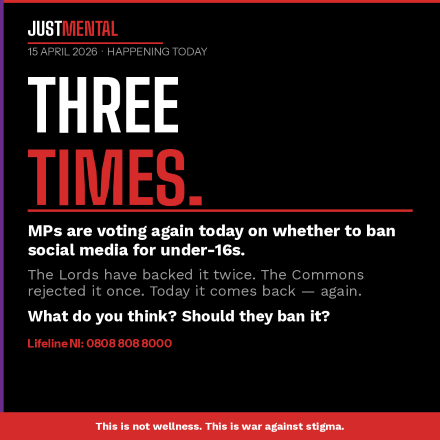
Today, the House of Commons votes on banning social media for under-16s. Again.
This is the third time in three months that Parliament has returned to this question. The Lords have backed a ban twice. The Commons rejected it once. And today, with the Children’s Wellbeing and Schools Bill back on the parliamentary schedule, the cycle continues.
JustMental has covered every stage of this story. We covered the Lords’ vote in January. We covered the Commons’ rejection in March. We are covering this again today, because every time Parliament delays, children continue to be exposed to the harms that drove this debate in the first place.
The Full Timeline
To understand why today matters, it helps to understand how we got here.
January 2026: The Lords Back a Ban: 261 vs 150
The Children’s Wellbeing and Schools Bill was making its way through Parliament when Conservative peer Lord Nash tabled an amendment that would ban under-16s from social media. The cross-party nature of the amendment was significant, it was co-sponsored by Labour and Liberal Democrat peers.
The Lords backed it by 261 votes to 150. The government opposed it. The argument from ministers was that they had just launched a three-month consultation and needed time to gather evidence. Critics, including Lord Nash, described the consultation as “a last-minute attempt to kick the can down the road.”
March 2026: The Commons Reject It: 307 vs 173
When the bill returned to the Commons on 9 March 2026, MPs voted to remove the Lords’ amendment. The final vote was 307 to 173. Over 100 Labour MPs abstained, including some who are openly sympathetic to the ban, highlighting internal party tension on the issue.
The government argued that a blanket ban could drive children into less regulated online spaces, and that the consultation launched in March would shape a more effective response. Critics countered that this was the same argument deployed to justify every previous delay.
In lieu of the Lords’ amendment, MPs backed government proposals giving Science Secretary Liz Kendall powers to restrict or ban children’s access to social media, chatbots and addictive features through secondary legislation rather than primary law.
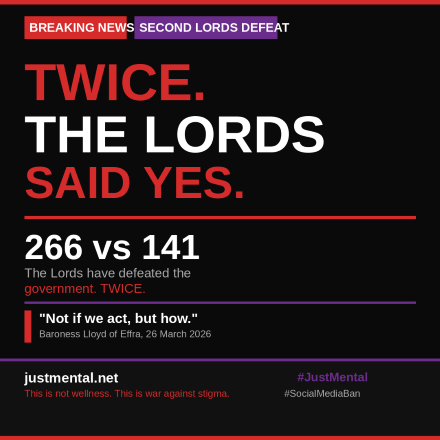
25 March 2026: The Lords Back It Again: 266 vs 141
The bill returned to the Lords on 25 March. In an even larger majority than before, 266 votes to 141, the Lords rejected the Commons’ amendments and reinstated Lord Nash’s original ban.
Lord Nash described the Commons’ rejection as “deeply disappointing” and pledged to continue fighting for the amendment. The bill then went back to the Commons for today’s vote.
15 April 2026: Today
The bill is scheduled for consideration in the Commons today. Once again, MPs must decide whether to accept the Lords’ position, reject it, or propose an alternative.
Why This Matters for Mental Health
This is not a technical parliamentary debate. It is a fight over whether the state will intervene to protect children’s mental health from platforms that were, by their own engineers’ admission, designed to keep users scrolling regardless of the harm.
The evidence for that harm is well-documented. Self-harm rates among teenagers rose sharply during the years social media became ubiquitous. Eating disorder presentations in adolescents increased significantly. Brianna Ghey, whose murder prompted widespread calls for action, had spent years exposed to harmful content on social media from the age of 14.
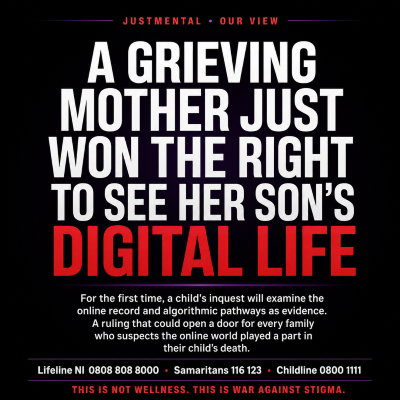
The Molly Russell case, in which a 14-year-old took her own life in 2017 after viewing self-harm and suicide content online, was followed by years of investigation, coroner’s findings, and parliamentary inquiry. The conclusion was unambiguous: the platforms facilitated access to content that played a direct role in her death.
And yet the government continues to consult.
The Northern Ireland Dimension
Northern Ireland has the highest suicide rate in the United Kingdom. It has the longest mental health waiting lists. It has communities where young people are already disproportionately vulnerable to the factors that social media algorithms exploit: loneliness, poor self-image, exposure to harmful content.
JustMental is not opposed to nuance in this debate. We recognise the genuine concerns raised by children’s charities that a blanket ban could push young people toward less regulated spaces. We recognise that implementation is complicated and that age verification is imperfect.
But we also recognise that every month of delay is another month in which the current situation continues. And the current situation is harming children.
What Happens Next
If the Commons rejects the Lords’ amendment again today, the bill enters further ping-pong. The Lords could insist on their amendment again, though parliamentary convention makes this increasingly unlikely the more it is rejected.
Alternatively, a compromise could emerge. The government has already given Liz Kendall new powers to act by secondary legislation, which could theoretically deliver a ban faster than primary law. Whether ministers use those powers, and when, remains to be seen.
The government’s consultation closes on 26 May 2026, with a promised response by summer 2026. For campaigners, that timeline feels very long. For the children being harmed today, it is longer still.
JustMental’s Position
JustMental does not campaign for a specific vote. We campaign for honesty in the conversation about mental health, and for the systemic failures that cause harm to be named and challenged.
On this issue, the systemic failure is clear: Parliament has known for years about the link between social media and children’s mental health. It has had evidence. It has had coroner’s reports. It has had bereaved parents standing at select committees telling their stories with extraordinary composure and courage.
What it has not yet had is the political will to act decisively.
We will continue to report on this story as it develops.
This is not wellness. This is war against stigma.
Lifeline NI: 0808 808 8000 — free, confidential, 24 hours a day.