
Under 16 social media ban: critics warn it won’t fix harm
Starmer’s under 16 social media ban is here, and the online safety community is divided. The UK has tonight become one of the strictest countries in the democratic world on children’s access to online platforms.
In a press briefing at Downing Street this morning, Prime Minister Keir Starmer announced what he described as a “full ban” on social media for all children under the age of 16, going further than the equivalent Australian ban introduced in December 2025. The announcement also includes new restrictions on gaming platforms and livestreaming services where children can communicate with strangers.
Regulation is expected to pass Parliament before Christmas. The ban is expected to come into force around spring 2027.
It is a major moment, and the third major Government move on Big Tech in just over a fortnight. Last week the PM gave Apple, Google and other device-makers three months to introduce on-device controls preventing children from sending sexually explicit imagery. Two weeks before that, the Westminster consultation on social media restrictions for under-16s closed.
This is what was decided.
What the under 16 social media ban covers
Per the official briefing, the announcement covers:
- All major social media platforms for under-16s, including but not limited to Instagram, TikTok, Snapchat, and other algorithmically-driven feeds.
- Gaming platforms restrictions on stranger-communication features that allow adults to contact children inside games without supervision.
- Livestreaming platforms, similar restrictions on children’s ability to broadcast or be contacted by adults during unsupervised streams.
- Timeline, regulation passes before Christmas 2026; full ban comes into force around spring 2027.
The Prime Minister told the briefing that he was “not prepared to compromise on the safety and happiness of our children.” He acknowledged that some social media companies would resist the move, and said the government would “fight back” if they did.
The voices in favour
Culture Secretary Lisa Nandy, speaking on BBC’s Sunday with Laura Kuenssberg ahead of the announcement, said the urgency was justified:
“The tech companies have had more than enough time to get their own house in order and to be able to create products to keep children safe online. If they’re not prepared to do it, they lose the right to market their products towards children, and I don’t think the government should be neutral about that.”
— Lisa Nandy, Culture Secretary
Esther Ghey, whose 16-year-old daughter Brianna was killed in 2023, told the BBC that the ban could “potentially save so many children’s lives.” She added, however, that the ban had to be accompanied by other measures, including continued government investment in after-school clubs and community youth provision. “We can’t just take things away from children,” she said.
The voices not in favour
The most prominent critique has come from a name that has been at the centre of UK online safety discussions for nearly a decade. Ian Russell, whose 14-year-old daughter Molly took her own life in 2017 after viewing harmful content on Instagram and Pinterest, has been campaigning for tighter regulation of social media platforms ever since.
He is not in favour of the ban.
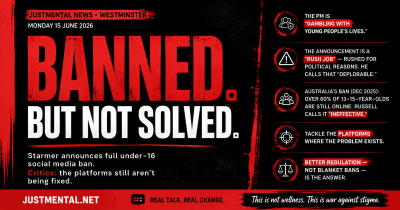
Speaking on the BBC’s Sunday with Laura Kuenssberg programme yesterday, Russell described the Prime Minister’s behaviour around the announcement as “deplorable”, accusing him of “playing politics” by rushing it through ahead of the summer recess for what Russell believes are political rather than child-safety reasons.
“Sledgehammer techniques like bans will only cause more problems.”
— Ian Russell, online safety campaigner, BBC, 14 June 2026
His critique is sharper than disagreement about timing. Russell argues that the ban does not hold the tech companies to account at the source. He says it removes children from harmful platforms without forcing those platforms to redesign the products that caused the harm, meaning, in effect, that the platforms keep operating exactly as they are, and the harms hit those same children the day they turn 16.
He also says that the Prime Minister personally promised him, in a father-to-father meeting last year, that the Government would focus on better regulation of tech companies rather than this approach.
On ITV’s Good Morning Britain this morning, Russell took the same argument further, this time with evidence. He called the Government’s announcement a “rush job” and pressed ministers to “tackle the platforms where the problem exists.” He then pointed to Australia’s existing under-16 social media ban, introduced in December 2025, as evidence that bans of this kind do not work as advertised.
“Over 60% of 13-to-15-year-olds who shouldn’t be online because of the ban there are still online.”
— Ian Russell on Australia’s ban, ITV Good Morning Britain, 15 June 2026
He called the Australian approach “ineffective.” For Russell, this is the most concrete point in the argument: a country that did exactly what the UK is about to do has not delivered the protection it promised. The kids found a way around it. Meanwhile, the platforms themselves continued to operate exactly as they were designed to.
“He’s gambling with young people’s lives,” Russell said.
Culture Secretary Lisa Nandy “respectfully disagreed” with him on the same programme.
The honest read
This is the JustMentalNews editorial position. It will not surprise regular readers.
The under 16 social media ban is a step. It is not the destination.
Just over two weeks ago we wrote about the $27 million settlement between Meta, Snap, ByteDance (TikTok) and Alphabet (YouTube), and Breathitt County School District in Kentucky. The companies paid the bellwether case to make it disappear before a verdict could set precedent. They did not admit liability. They did not agree to change anything about the platforms.
That fact has not changed. Today’s announcement does not change it. Today’s announcement removes children from the platforms, it does not fix the platforms. The same algorithms, the same recommendation systems, the same infinite scroll mechanics that made the platforms unsafe for under-16s also make them unsafe for everyone else. The platforms get to keep operating as they are. They just get to do so without minors.
On that specific question, is the source of the harm being addressed, or is the symptom being managed? Ian Russell is right. We have written that same argument across the past three weeks. The strongest moves of the past month have all been about removing children from harmful environments. None has been about forcing the environments themselves to change.
The ban will protect some children. It will save some lives. That matters and is not in question.
But the question that does not go away, even with this announcement, is the question of platform design. Until Big Tech is forced to fix what their products do, not just who their products do it to, the work continues.
For Northern Ireland
The under 16 social media ban is UK-wide and will apply in Northern Ireland the same as in England, Scotland and Wales. The Westminster Government has the powers required.
NI’s children use the same algorithms as the rest of the UK. The protection, and the critique of it, applies here too.
If you are a young person reading this and you are struggling, you do not need to be in crisis to ask for help.
Lifeline NI: 0808 808 8000 (free, confidential, 24/7).
Childline: 0800 1111 (for under-19s).
Samaritans: 116 123 (free, 24/7).