
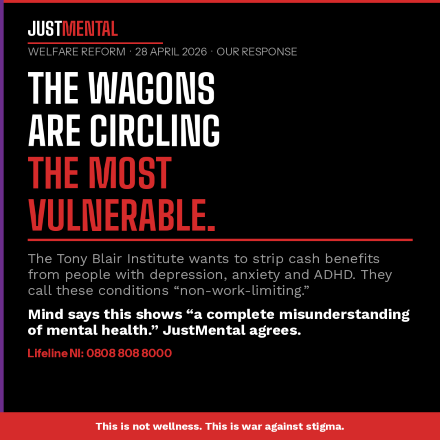
The Wagons Are Circling the Most Vulnerable. JustMental Responds.
Yesterday, the Tony Blair Institute published welfare reform mental health proposals that should concern every person who has ever experienced depression, anxiety, ADHD, or any other condition that others cannot see. Their report, published on 28 April 2026, proposes to classify these conditions as ‘non-work-limiting’, stripping cash benefits from some of the most vulnerable people in society and replacing them with treatment and ‘employment support.’
Mind UK responded within hours. Tom Pollard, Head of Policy, said the proposals show “a complete misunderstanding of both mental health and the benefits system.”
JustMental agrees. And we have more to say.
What the Welfare Reform Mental Health Proposals Actually Say
The Tony Blair Institute, the think tank founded by former Prime Minister Sir Tony Blair, wants the government to pull what they call an ‘emergency handbrake’ on welfare spending. At the centre of their proposal is a new category: ‘non-work-limiting conditions.’ Under their plan, people with depression, anxiety, ADHD, stress-related disorders and some neurodevelopmental conditions would no longer automatically qualify for cash benefits.
Instead, they would receive treatment, rapid-access mental health provision, therapy, workplace support. The underlying argument is that these conditions are, in most cases, compatible with work, and that keeping people on long-term benefits is actually bad for their health.
There are elements of that argument that are not wrong. Work, where it is good work with proper support, can be beneficial to mental health. The welfare system does have genuine structural problems. Benefit dependency without a clear route forward is not a compassionate outcome for anyone.
But the way the Tony Blair Institute proposes to get there is where JustMental parts company with them completely.
The Facts They Are Not Telling You
The TBI’s own report reveals something that has been almost entirely absent from the media coverage of their proposals today. According to their own figures, around three-fifths, 60 per cent, of the total UK welfare bill goes to pensioners, primarily through the state pension.
The working-age health and disability payments they are targeting represent a significant but much smaller portion of total welfare spending. Yet the entire welfare reform mental health narrative is framed around people with mental health conditions, as if they are the primary driver of the welfare bill’s growth.
We have a simple question. If the welfare bill is the problem, why are we not having the same conversation about pensions? Nobody is suggesting we start ‘picking off’ pensioners to bring the bill down. Nor should we. And by the same logic, we should not be targeting those who go through severe and debilitating mental illness simply because their condition is harder to see.
Mind UK’s Response
Mind UK did not hold back. Tom Pollard, their Head of Policy, said:
“This proposal shows a complete misunderstanding of both mental health and the benefits system. The only thing it would achieve would be the undermining of years of progress towards greater awareness and knowledge around mental health. A blanket rule to declare certain conditions ‘non work-limiting’ fails to recognise the impact living with conditions like depression or anxiety can have on somebody’s life. People do not get additional benefits because of a diagnosis. Decisions are based on a functional assessment of how health conditions or impairments impact people’s ability to work and live independently.”
JustMental endorses that statement in full. Mental health conditions are not monolithic. Two people with the same diagnosis can have profoundly different levels of functional ability. The idea that you can draw a clean line around depression or anxiety and say ‘this does not limit your ability to work’ as a blanket default demonstrates exactly the misunderstanding Mind has identified.
What JustMental Believes
We are not arguing that the welfare reform mental health debate is unnecessary. It is overdue. What we are arguing is that the way the Tony Blair Institute proposes to conduct it is wrong. The system has genuine problems around incentives, assessment quality, and the lack of a clear route from benefits back into employment. JustMental supports reform that is evidence-based, compassionate, and built around the genuine needs of the people it affects.
What we are arguing is this:
Invest in prevention
The welfare bill for mental health conditions is rising because mental illness is rising. You do not reduce the cost of mental illness by removing cash benefits from people who have it. You reduce the cost by investing in prevention, in early intervention, in community mental health services, in breaking the stigma that stops people seeking help before crisis. You gotta speculate to accumulate. Spend it where it is needed, and you will see the return.
Break the stigma
Classifying depression, anxiety and ADHD as ‘non-work-limiting’ sends a message to the public: these conditions are not serious. That message does not just affect benefits. It affects every workplace conversation about mental health, every person who has been afraid to tell their employer they are struggling, every teenager who thinks their mental health problems are not real enough to deserve support. Years of stigma-reduction work could be undone in a single piece of secondary legislation.
Chase the real money
If the government wants to reduce the deficit and fund better services, there is a more productive place to look than the benefits of people with depression. Billions of pounds are lost to tax avoidance every year, through loopholes that large corporations and wealthy individuals can afford specialist advice to navigate, but that ordinary working people cannot. The government has the power to close those loopholes. It chooses not to, or moves too slowly. That is a choice. Targeting people with mental health conditions for welfare cuts while leaving tax avoidance essentially intact is not fiscal responsibility. It is political choice dressed up as economic necessity.
Properly pursue benefit fraud
Genuine benefit fraud is a real problem and should be pursued rigorously. JustMental has no objection to stronger enforcement against those who are fraudulently claiming benefits they are not entitled to. What we object to is treating everyone who claims mental health-related benefits as a potential fraud risk, which is the cultural consequence of the kind of narrative the TBI report promotes.
What JustMental Is Asking of Northern Ireland’s Politicians
Northern Ireland has the highest suicide rate in the United Kingdom. It has the longest mental health waiting lists. It has communities where the consequences of inadequate mental health support are measured in lives. The people who would be most affected by the Tony Blair Institute’s proposals are not abstractions on a spreadsheet. They are our neighbours, our family members, the people who come to JustMental looking for a space where their experience is taken seriously.
JustMental is calling on every Northern Ireland MP, regardless of party, to stand up in Parliament and ensure that the most vulnerable voices in our society are heard in this debate. When welfare reform mental health proposals are discussed at Westminster, the specific and disproportionate impact on Northern Ireland must be named explicitly, not treated as a footnote.
And we are calling on the Northern Ireland Executive to do everything within its devolved powers to protect the people most at risk. The Executive controls health and social care. It has the power to invest in community mental health services, in early intervention, in the kind of prevention that actually reduces the long-term cost of mental illness. That investment is not a luxury. It is the alternative to the race to the bottom that the Tony Blair Institute is proposing.
The most vulnerable people in our society deserve to be heard. Not managed. Not classified. Not told that their suffering is ‘non-work-limiting’ by people who have never experienced it.
Heard.
This is not wellness. This is war against stigma.
Lifeline NI: 0808 808 8000 — free, confidential, 24 hours a day.