
PMDD: What It Is, Why the System Keeps Getting It Wrong, and Why It Matters for Mental Health
This week, Vicky Pattison appeared on Good Morning Britain to talk about her Channel 4 documentary, Vicky Pattison Investigates: Medical Misogyny. She described waiting five years for a diagnosis. She described suicidal thoughts, crippling anxiety, and exhaustion that doctors dismissed as normal period symptoms. She described being told, by medical professionals, that she was making too much fuss.
She is not an isolated case. She is the norm.
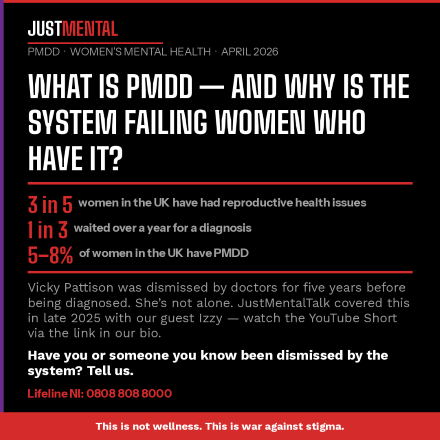
Premenstrual Dysphoric Disorder, PMDD, affects an estimated 5 to 8 percent of women and people who menstruate in the UK. It causes severe anxiety, depression, suicidal thoughts, and debilitating physical pain in the weeks before menstruation. And it is routinely dismissed, misdiagnosed, or simply not recognised by the GPs who are supposed to catch it.
JustMentalTalk covered PMDD in late 2025 with our guest Izzy, who shared her own experience with extraordinary candour. If you haven’t seen that conversation, the YouTube Short is linked in our bio.
Today, we want to set the context for why Vicky Pattison’s campaign matters, and why mental health organisations like JustMental should be talking about it.
What Is PMDD?
Premenstrual Dysphoric Disorder is a severe, often debilitating form of premenstrual syndrome. Where PMS is common and causes mild-to-moderate discomfort, PMDD causes symptoms that are significantly more intense and have a far greater impact on daily functioning.
According to mental health charity Mind, PMDD is a hormone-related mood disorder. Symptoms typically occur in the one to two weeks before menstruation and include:
- Extreme anxiety, panic attacks, and feeling overwhelmed
- Severe depression, hopelessness, and in some cases suicidal thoughts or ideation
- Intense mood swings, irritability, and anger that feel disproportionate and uncontrollable
- Brain fog, concentration difficulties, and memory problems
- Physical symptoms including extreme fatigue, pain, bloating, and breast tenderness
- Withdrawal from relationships, work, and activities that would normally bring pleasure
The condition is cyclical, it appears, typically, in the luteal phase of the menstrual cycle and lifts within days of menstruation starting. That cyclical pattern is both a diagnostic indicator and a source of additional difficulty: the person may feel fine for two weeks, then be floored for another two, with no warning and no reliable way to prevent it.
Why Is It So Frequently Missed?
The diagnostic picture for PMDD in the UK is poor. A GMB investigation found that three in five women in the UK have experienced reproductive health problems. A third waited more than a year for a diagnosis. More than half reported receiving a misdiagnosis, with many saying they felt dismissed by doctors.
Several factors contribute to this:
1. Medical training gaps
PMDD is not prominently featured in standard UK medical training. Many GPs, as Vicky Pattison noted, have limited knowledge of the condition. A person presenting with severe depression in the week before their period may be offered antidepressants and sent away. The cyclical nature of the symptoms, the key diagnostic clue, may never be explored.
2. The normalisation of female pain
Women’s pain has been systematically underestimated and undertreated in Western medicine for decades. The research is extensive. Women wait longer in A&E. They are more likely to have their pain attributed to psychological causes rather than physical ones. They are more likely to be told to ‘manage’ what they are experiencing rather than have its root cause investigated.
PMDD sits squarely in this pattern. ‘It’s just PMS’ is a phrase that appears again and again in the accounts of women who eventually receive a PMDD diagnosis, sometimes after years, sometimes after a decade, of being dismissed.
3. The private healthcare route
Vicky Pattison, like many PMDD sufferers, ultimately paid for a private appointment to receive her diagnosis. That is not a solution, it is a privilege. The women who cannot afford private healthcare continue to wait, and continue to suffer, in a system that has not yet built the structures to properly identify what they have.
The Mental Health Connection
PMDD is not ‘just’ a gynaecological condition. Its primary symptoms, severe depression, suicidal ideation, anxiety, and loss of functioning, are mental health symptoms. A person experiencing PMDD may present at crisis services, may be prescribed medication for depression or anxiety that only partly addresses the underlying cause, and may spend years in a mental health system that is treating the symptoms without identifying the root.
For JustMental, this is directly within our remit. The mental health system’s failure to recognise PMDD is a systemic failure. It is not a result of individual GP incompetence. It is the result of inadequate training, inadequate commissioning, and a healthcare culture that has historically not taken women’s experiences seriously.
That is what Vicky Pattison means by medical misogyny. It is not an accusation of intentional prejudice. It is an accurate description of a structural bias that has real consequences for real people.
What Needs to Change
Vicky Pattison has called on Health Secretary Wes Streeting to address this through:
- Better PMDD education in schools, so that women and girls understand their bodies before they enter a healthcare system that may fail them
- Improved GP training, so that PMDD is recognised earlier and treated appropriately
- Legislative change to ensure timely diagnosis and proper treatment pathways within the NHS
- Better access to resources, both online and through local health hubs
These are not unreasonable asks. They are baseline requirements for a healthcare system that takes women’s mental and physical health seriously.
JustMentalTalk Covered This in 2025
In late 2025, JustMentalTalk welcomed Izzy as a guest to discuss her experience of PMDD. She spoke about the years it took to be heard, the impact on her relationships and her work, and what finally getting a diagnosis meant to her.
That conversation is available as a YouTube Short via our bio link. We encourage anyone who has wondered whether what they experience each month might be more than PMS to watch it, and to know that they are not alone, they are not imagining it, and they deserve proper care.
This is not wellness. This is war against stigma.
If you are struggling with your mental health: Lifeline NI: 0808 808 8000, free, 24 hours a day.