
Stress Awareness Month 2026: Beyond the Graphics, What Actually Changed?
JustMental · 29 April 2026 · Stress Awareness Month
Stress Awareness Month 2026 is nearly over. April has been Stress Awareness Month every year since 1992, a designated moment in the calendar to raise public understanding of stress, its causes, its consequences, and what can be done about it. The campaign was founded by the Stress Management Society over three decades ago.
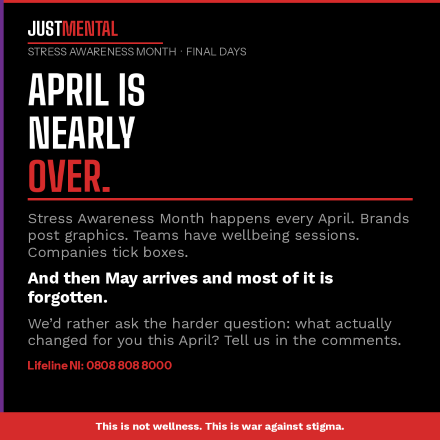
And every year, a familiar pattern plays out. Brands post graphics. HR teams schedule wellbeing sessions. Companies send emails about self-care. Mental health charities publish resources. And then May arrives, the ribbons come down, and most of it is forgotten until the following April.
JustMental is not interested in participating in that cycle. So as April draws to a close, we want to ask the question that the month is supposed to prompt but rarely does: what actually changed?
What Stress Awareness Month Is Supposed to Be
Stress Awareness Month was established to do something genuinely useful: to shift public understanding of stress from a personal failing to a systemic issue. The founding premise was that stress is not simply a matter of individual resilience or coping skills. It is shaped by workplace conditions, economic pressures, housing security, social isolation, healthcare access, and the structures within which people live and work.
That is a sophisticated and important framing. The problem is that it rarely survives contact with how the month is actually observed. In practice, Stress Awareness Month has become dominated by individual-level interventions, breathing techniques, mindfulness apps, self-care tips, that locate the solution to stress within the person experiencing it, rather than in the conditions creating it.
A month that began as a challenge to systemic causes has largely become a vehicle for individual wellness content. That is not nothing, individual coping strategies have genuine value, but it is a long way from the original intent.
What the Data Shows About Stress in Northern Ireland
Northern Ireland has consistently reported higher rates of mental health difficulties than other parts of the United Kingdom. The reasons are complex and well-documented: the legacy of the Troubles, intergenerational trauma, higher rates of economic deprivation in certain communities, rural isolation, and mental health waiting lists that remain among the longest in these islands.
Stress is not separate from this picture. It is woven through it. The stress of waiting two years for a psychology appointment. The stress of precarious employment. The stress of managing a household on a fixed income as costs rise. The stress of caring for a family member with complex needs in a system that does not adequately support carers.
None of those stressors are addressed by a breathing exercise. All of them require systemic action.
Workplace Stress: The 2026 Picture
One of the most significant sites of stress in 2026 is work, or the conditions around it. According to figures published by the Health and Safety Executive in November 2025, 22.1 million working days were lost to work-related stress, depression or anxiety in Great Britain in 2024/25, a record high. An estimated 964,000 workers were affected. That is real human cost: people unable to function, relationships strained, physical health deteriorating, livelihoods threatened.
Employers have become increasingly fluent in the language of mental health and wellbeing. Employee Assistance Programmes, mental health first aiders, wellbeing policies, and awareness campaigns are now commonplace in larger organisations. Whether this has translated into actual reductions in work-related stress is a harder question, and one that the HSE figures, which show a year-on-year increase rather than decrease, do not answer confidently in the affirmative.
Awareness without structural change does not reduce stress. Knowing that stress exists does not address the workload that is causing it, the management culture that is sustaining it, or the economic conditions that are making it worse.
The Harder Question
So as April ends: what changed?
For some people, genuinely: something. A conversation that hadn’t happened before. A colleague who finally felt safe enough to say they were struggling. An employer who responded to awareness month by reviewing their policies rather than just posting about them. A person who found a resource or a community that helped.
JustMental does not dismiss those outcomes. They matter. People matter.
But at the systemic level, the honest answer is: not much. The mental health waiting lists in Northern Ireland remain among the longest in the UK. The structural conditions that generate stress for the most vulnerable people have not been meaningfully addressed in a month. And on 1 May, the corporate wellness machine will move on to the next awareness month, and the people who are genuinely struggling will still be there.
What JustMental Believes Needs to Change
This is not a counsel of despair. It is a demand for honesty about what awareness campaigns can and cannot do, and a call for the action that needs to accompany them.
- Mental health waiting times in Northern Ireland must be addressed as a political priority, not a perennial aspiration. The Health Minister has the power to act, and he has spoken to JustMental directly about that responsibility. The Assembly has the responsibility to hold him accountable.
- Workplace stress must be addressed through enforcement of existing legislation, not just voluntary initiatives. The Health and Safety Executive has powers under the Health and Safety at Work Act 1974 and the Management of Health and Safety at Work Regulations 1999 that it could use more aggressively.
- Carers, one of the most consistently stressed groups in any population, need more than a Carers’ Week. They need adequate respite provision, financial support, and healthcare access that reflects the reality of what they carry.
- The link between economic stress and mental health must be acknowledged explicitly in policy, not treated as a separate domain. Poverty is a mental health issue. Housing insecurity is a mental health issue. Food poverty is a mental health issue.
Stress Awareness Month ends on Thursday. The conversation about stress does not.
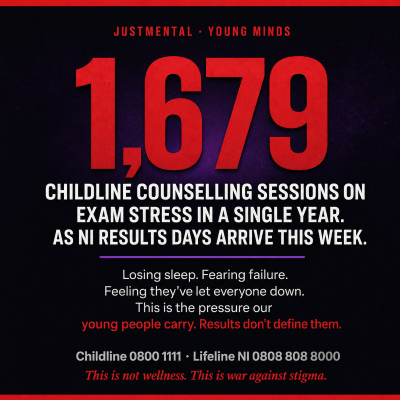
If you are carrying something heavy as April closes, whether that is work pressure, exam anxiety, financial worry, caring responsibilities, or something you haven’t quite been able to name, you do not have to keep carrying it alone. You can hear the conversations we are having on JustMentalTalk, and you can reach Lifeline NI any time, day or night.
This is not wellness. This is war against stigma.
Lifeline NI: 0808 808 8000 — free, confidential, 24 hours a day.