
Children’s Mental Health Northern Ireland: Why We Can’t Count Our Waiting Children │ JustMental
Children’s mental health Northern Ireland statistics have a gap at the centre of them: more than a year on, we still don’t know how long our own children are waiting for help.
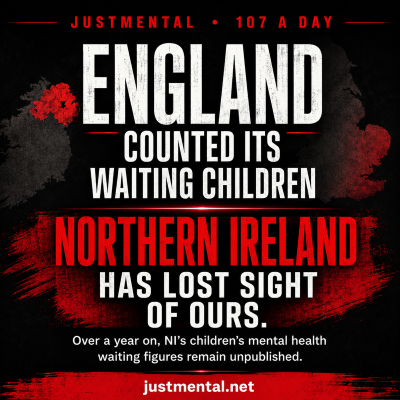
England Can Count Its Waiting Children. Northern Ireland Has Lost Sight of Ours.
A new report from the Children’s Commissioner for England has put a number on a crisis: more than one million children referred to mental health services in a single year. Northern Ireland cannot produce the same number for its own children, because, more than a year on, the figures still have not been published.
More than one million children in England had an active referral to mental health services in 2024–25, the equivalent of roughly one in every ten children. The figure, 1,048,965, is almost double the number recorded in 2018–19, and a rise of nearly ten per cent on the previous year. It comes from the fifth annual report of the Children’s Commissioner for England, Dame Rachel de Souza, published this week.
Anxiety was the single most common reason for referral, accounting for around 16 per cent of all cases. Referrals for suspected autism rose by almost half in one year, climbing from 65,530 to 96,393. Referrals for other neurodevelopmental conditions, including ADHD and Tourette’s syndrome, rose by nearly a quarter. More than 60,000 children had been waiting over two years for support, up from over 44,000 the year before.
Dame Rachel did not soften it. She described the figures as “stark”, and said roughly one in ten children in England now has an active referral to mental health services, a measure, in her words, of the sheer scale of distress young people are facing.
Children’s mental health Northern Ireland: a report we can’t write
It would be easy, and wrong, to lift those numbers and present them as Northern Ireland’s. The Children’s Commissioner for England has no remit here. These are NHS England figures, drawn from England’s services. Our equivalent watchdog is the Northern Ireland Commissioner for Children and Young People, currently Chris Quinn, and our services are run separately through the five Health and Social Care Trusts.
But the England report matters here for a reason that should trouble anyone who cares about children in this place. England has just demonstrated something Northern Ireland currently cannot: it counted its waiting children. Right down to the last child, broken down by condition, by length of wait, by region, by spend per head.
Northern Ireland cannot currently do that. The Department of Health publishes Child and Adolescent Mental Health Service, CAMHS, waiting-time statistics on a quarterly basis. The most recent published set covers the position at 31 March 2025. And even that set is incomplete: Belfast Trust figures from June 2024 to March 2025 were excluded because of the roll-out of the new Encompass patient-record system, and Northern Trust figures for December 2024 and March 2025 were excluded for the same reason, which means the Northern Ireland total itself is incomplete.
Since then, the publication has effectively stopped. After the final two Trusts went live with Encompass on 8 May 2025, the Department stated that no further updates to the CAMHS waiting-time publication would be available until full quality assurance on the new data source has been completed. That position still stands.
The part that should sting
Here is what makes the silence harder to accept. The same Encompass system is now producing current figures for other services. The Department has published outpatient, inpatient, diagnostic and emergency-care waiting times right up to the position at 31 March 2026, labelling them “official statistics in development”, figures to be treated with caution, but published all the same.
So the system can release current numbers for hospital waiting lists and emergency departments. For children’s mental health waiting lists specifically, it has not. Children’s mental health, the area where early intervention matters most, where a year on a list can mean a year of a young life put on hold, is the corner of the system we currently cannot see into.
The last reasonably complete snapshot is now well over a year old. Following the publication of CAMHS waiting-time statistics in May 2024, Alliance health spokesperson Nuala McAllister MLA noted that 52 per cent of children on the list were waiting more than nine weeks for an assessment. That figure is dated, and we present it as exactly that, the last clear view we had, not the position today. The point is precisely that we no longer have a current one.
It is worth holding the two thresholds side by side. England is measuring, and being held to account for, waits of more than two years. Northern Ireland’s last published measure was waits of more than nine weeks. We are not even counting in the same units. And right now, we are not counting at all.
Where the early help went
None of this sits in isolation. The Healthy Happy Minds pilot, which brought counselling into primary schools, began in 2021. It was stood down in 2023 amid budgetary pressures, with no replacement primary-school counselling service put in its place. Early intervention is the cheapest and kindest point at which to help a struggling child. It is also, repeatedly, the first thing cut.
The wider strategic picture offers little comfort. The Department of Health’s own review of the Mental Health Strategy found that, as of the end of 2024–25, only around 16 per cent of the funding deemed necessary to deliver the strategy had been allocated. The ambition exists on paper. The money to deliver it, repeatedly, does not follow.
This is not just about teenagers, and it is not just about boys
There is a lazy version of this conversation that imagines the children’s mental health crisis as a story about secondary-school teenagers, or about boys. The England data refuses that. The fastest-growing referral reasons include suspected autism and neurodevelopmental conditions in children of primary-school age and younger. Anxiety cuts across every age, every background and every postcode. Mental health does not check a child’s school year, their gender or their parents’ income before it arrives.
That is exactly why this matters to everyone reading this, not only to parents currently sitting on a waiting list. A society that cannot see how long its children are waiting cannot honestly claim to be acting on it.
What we are asking for
JustMental’s 107 a Day campaign has one simple principle running through it: you cannot fix what you refuse to measure in public. That principle applies here with full force.
- Publish the CAMHS waiting-time figures. If Encompass can produce current outpatient and emergency-care data, it can produce current children’s mental health waiting data. If quality assurance is genuinely incomplete, publish what exists with the caveats attached, exactly as has been done for every other service.
- Set a date. A clear, public timetable for when complete CAMHS waiting-time reporting will resume, with monthly transparency thereafter.
- Restore early help. Reinstate a primary-school counselling provision to fill the gap left when Healthy Happy Minds was stood down.
- Give children their own line in the strategy. As the Children’s Commissioner for England has argued for her jurisdiction, children’s mental health needs a dedicated, jointly owned focus across health and education, not a footnote inside an adult-shaped plan.
That’s the fix children’s mental health Northern Ireland services need most. England counted its waiting children this week and did not like what it saw. Northern Ireland deserves at least the dignity of being able to do the same, and then the courage to act on the answer, the least anyone advocating for children’s mental health Northern Ireland can ask for.
If you or a young person you know is struggling
Support is available, day and night.
- Lifeline (NI crisis helpline): 0808 808 8000 — free, 24/7
- Childline (for under-19s): 0800 1111 — free, confidential, 24/7
- Samaritans: 116 123 — free, 24/7
- SHOUT: text 85258 — free, 24/7 text support
If a child or young person is in immediate danger, contact 999.
Reported in line with Samaritans media guidelines. JustMental: justmental.net | info@justmental.net