
Northern Ireland Mental Health Waiting Times: The Department of Health Just Told Us It Isn’t Publishing Them, and Then Missed Its Own Promise to Start
Why we filed the FOI
On Tuesday 30 June 2026, JustMental launched the 107 a Day campaign, calling for the establishment of a 24/7 Mental Health Crisis Response Team in each of Northern Ireland’s five Health and Social Care Trust areas. The campaign was built around figures placed on the public record by Assistant Chief Constable Ryan Henderson at the joint Stormont Health and Justice Committees in November 2024, approximately 39,000 concern-for-safety calls received by the PSNI each year, around 107 per day, with only 3% relating to crime, at an estimated cost to the police service of around £4 million per year.
The campaign’s central argument is that the phased introduction of the Right Care, Right Person model, the operational framework under which non-crime mental health incidents transfer from policing to the health service, cannot proceed safely without the receiving infrastructure being in place. To move that argument from advocacy into evidence, JustMental submitted a Freedom of Information request to the Department of Health on 30 July 2026 asking five questions about the current state of the data underpinning that infrastructure.
The Department’s response arrived on 26 August 2026 under reference DOH 2026-0189. It is now on JustMental’s desk. It confirms, in writing, five separate things that Northern Ireland’s Assembly, its media, and its public should stop and consider carefully.
One: children in Northern Ireland have been effectively erased from the mental health waiting time record for fifteen months
The Department confirmed that its quarterly publication of Child and Adolescent Mental Health Service (CAMHS) waiting times, the single most-cited data source for public scrutiny of children’s mental health services in Northern Ireland, has not been published since May 2025.
An internal Departmental notification, dated 22 July 2025 and released to JustMental as part of the FOI response, records the moment publication was formally suspended. The notification confirms: due to the rollout of the Encompass electronic patient record system, CAMHS waiting time data was only available for two of the five HSC Trusts by April 2025. When the final two Trusts went live with Encompass on 8 May 2025, the Department paused all further monthly publication until quality assurance on the new data source could be completed.
Fifteen months later that quality assurance is still not complete. At the time of publication of this article, the Department’s own CAMHS statistics landing page continues to display the March 2025 release as its “current publication” and the July 2025 suspension notice remains in place. The most recent complete Northern Ireland-wide CAMHS waiting times picture available to the public is for the quarter ending 31 March 2024. That figure is now nearly twenty-nine months out of date.
And even that figure was incomplete. Reviewing the last published quarter alongside the FOI’s own data tables, the Belfast HSC Trust, Northern Ireland’s largest Trust and the largest single provider of CAMHS services in the country, was absent from published CAMHS waiting time data from the quarter ending June 2024. Belfast has therefore been off the CAMHS waiting time record for well over fourteen months. Northern Trust was absent from December 2024 onwards. Whatever the aggregate published figure means, it has not meant “Northern Ireland” for two years.
Two: the Department made a written commitment in this FOI response, and missed it within a day
At the point of drafting the FOI response, the Department told JustMental in writing that a June 2026 CAMHS publication was “provisionally scheduled for publication on 27 August 2026”, contingent on ongoing quality checks and verification by the HSC Trusts.
That commitment was dated 26 August 2026. It was given under statutory response to a Freedom of Information request. As of the time of publication of this article on Friday 28 August, the Department’s own CAMHS statistics landing page has not been updated. The June 2026 release has not appeared. The March 2025 publication remains listed as current. The 22 July 2025 suspension notice is still on the page.
A publication commitment made in writing under statute. Missed within twenty-four hours. This is not a minor administrative slip. It is what a Department in a functioning system does not do.
Three: no equivalent routine publication exists for adult mental health waiting times, and none will resume
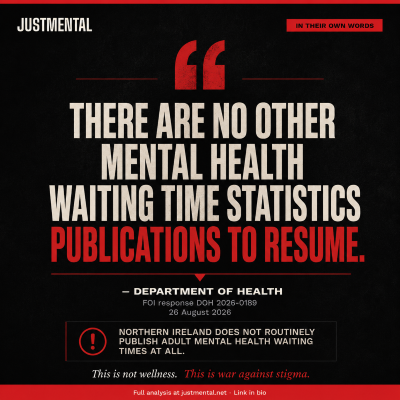
There are no other mental health waiting time statistics publications to resume however it is hoped to initiate other mental health publications when we are content that the information is fit for purpose.
That is the Department of Health’s own written response, verbatim. Read it twice. It confirms that Northern Ireland does not routinely publish waiting time statistics for Adult Mental Health Services. There is no quarterly report. There is no monthly bulletin. There is no public data series for the 9-week Ministerial adult mental health assessment target. There is no equivalent for Northern Ireland of the NHS England Mental Health Services Monthly Statistics, the Public Health Scotland CAMHS and psychological therapies waiting times releases, or the Welsh Government’s CAMHS first-appointment series.
What the Department was able to provide, in response to the questions about adult mental health waiting times, was a set of management information tables sourced from HSC Trust manual returns. The Department itself attaches to those tables a notes and caveats section stating clearly that the information is “management information collected for operational and reporting purposes”, “subject to revision following validation”, and, critically, “not official statistics, nor is it intended for publication”. The confidence-level colour coding applied to every Trust-quarter across the tables is heavily weighted toward Low and Medium, with entire quarters of Belfast and South Eastern Trust data missing altogether.
These are the figures the Department has to go on. They are the figures the Assembly has to go on. They are the figures a family, a clinician, or a journalist trying to understand the state of adult mental health provision in Northern Ireland now has to work from, because there are no others.
Four: the Department refused to disclose the operational baseline for Right Care, Right Person
The fifth question in the JustMental FOI asked for two specific things: the current operational baseline being applied by the Department to the phased introduction of Right Care, Right Person in Northern Ireland, and any documents recording the Department’s own assessment of the mental health service capacity required to support safe implementation of that model.
The response addressed neither. Instead, the Department pointed JustMental to a July 2023 Ernst & Young Mental Health Workforce Review, a document that pre-dates the operational rollout of Right Care, Right Person in Northern Ireland by nearly two years and does not, on any fair reading, address the operational baseline or the capacity assessment the question sought.
This is an evasion. It leaves three possibilities, each of which requires a different form of response under the Freedom of Information Act. Either the operational baseline documentation for Right Care, Right Person exists and the Department chose not to disclose it. Or documentation exists in part and elsewhere in the system, with Trusts, the Public Health Agency, or the Strategic Planning and Performance Group, and the Department did not exercise its Section 16 duty to advise and assist. Or no such documentation exists anywhere, and a policy transferring mental health crisis response from policing to the health service is being rolled out on people in acute mental health crisis without a documented capacity assessment. Any of those three answers is material. Substituting an unrelated 2023 workforce review is not.
JustMental has today lodged a formal request for internal review of this element of the response, within the two-month window permitted under section 45 of the Freedom of Information Act. If the internal review is inadequate, the matter will be escalated to the Information Commissioner’s Office.
Five: the framing the Department was preparing for the media
Appendix 2 of the FOI response contains an internal Departmental email chain dated 30 June 2026, the same day the 107 a Day campaign launched, in which the Department prepared a media response to a query from the BBC Nolan Show about children’s mental health waiting lists. Two lines from that draft response are worth pausing on.
The first states that “CAMHS Referrals Accepted and Age Bands of those Referrals accepted in the 0-4, 5-11 and 15-17 age bands are lower in 2024 than in 2020”. The 2020 comparison quietly relies on the year of the COVID-19 lockdowns, which the Department’s own previous statistical publications acknowledge marked the low point in CAMHS demand, 1,107 total waits at 30 September 2020, subsequently rising to 2,388 at 31 March 2023. Comparing 2024 figures to a pandemic-year low and presenting the result as improvement is not a neutral use of data.
The second states that “waiting lists are on the downward trajectory”, based on referrals accepted falling from 3,830 in 2021-22 to 3,213 in 2023-24. Referrals accepted is an input measure, not a backlog measure. Fewer referrals accepted may mean fewer children in need are being seen, not that those already waiting are being seen faster. The Department’s own last complete CAMHS publication (June 2023) recorded 60% of children waiting more than nine weeks for a CAMHS assessment, a persistent breach of the Ministerial 9-week target that was set to prevent exactly that. That is not a downward trajectory. It is a plateau at a level of failure the target was designed to prevent.
Five years of regulatory warning. Not fixed. Materially worse.
None of what this FOI response contains is new. In September 2021, the Office for Statistics Regulation, the UK statistical regulator, published a review of mental health statistics in Northern Ireland, finding a scarcity of robust data, significant gaps, fragmented technology infrastructure, and statistics that were difficult for users to locate. In its 2023 report on mental health services in Northern Ireland, the Northern Ireland Audit Office reinforced these findings, adding that the Department and the Trusts “cannot determine whether the services provided improve patient mental health and reflect value for money”.
Five years on, the FOI response now on JustMental’s desk confirms that the position is not merely unchanged but has materially deteriorated. The one mental health waiting time publication that was working, quarterly CAMHS releases, has been off the record for fifteen months. The Department has confirmed in writing that no equivalent adult publication exists to resume. The rollout of Encompass, the technology upgrade that was meant to fix data quality, has instead knocked out the publication series it should have improved.
It has to be said plainly. A five-year regulatory warning that has not been acted on, resulting in a mental health data blackout during the introduction of a policy that transfers crisis response from policing to a health service the public cannot scrutinise, is a scandal. It has been visible in plain sight. It has been allowed to happen because there has not been sustained public accountability. This article is JustMental’s contribution to that accountability.
What this means for the incoming Health Minister
On Thursday 20 August 2026, Robbie Butler MLA (UUP, Lagan Valley) was appointed Minister of Health, succeeding Mike Nesbitt following the latter’s resignation. Butler took office six days before the Department dated this FOI response. The material now in front of him was drafted by officials under his predecessor’s watch and lands on his desk in his first fortnight in the role.
The fifteen-month CAMHS suspension is not on Robbie Butler personally. The absence of adult mental health publications is not on him personally. The refusal to disclose the Right Care, Right Person operational baseline was not his refusal to make. But it is now on his desk, and how he responds, whether by directing officials to resume publication, by producing the RCRP baseline, by inviting scrutiny, will define whether he continues the transparency failure or breaks with it.
JustMental will engage constructively with the new Health Minister on this material. The 107 a Day campaign is not building toward blame. It is asking for the receiving infrastructure, the data, and the transparency that any safe and sustainable introduction of Right Care, Right Person would require. That ask remains open to the Minister of Health, and to the Minister of Justice with whom the model must be delivered jointly.
What JustMental is doing next
Three things. Firstly, a formal request for internal review has today been submitted to the Department of Health on the failure to disclose or produce the operational baseline for Right Care, Right Person. Secondly, when the Assembly returns from summer recess in the first week of September 2026, the campaign will write to every Member of the Northern Ireland Assembly with a briefing pack that draws on these FOI findings, requesting Assembly Questions, letters to Ministers, and committee-level engagement. Thirdly, the full FOI documents, the response letter, the data tables, and the internal Departmental correspondence, are published in full at the foot of this article for public download.
The 107 a Day campaign asked the Department of Health what the data says. The data says the data is not being published. That is a statement about the state of the mental health system in Northern Ireland, and it is also a statement about the state of the accountability that surrounds it. This is not wellness. This is war against stigma. And it is war against silence.
If reading this has been difficult
Reading about long waits for mental health care can be hard, especially if you or someone you love is currently waiting for support. Please do not wait alone. If you need someone to talk to right now, whether or not you feel you are in crisis, support is available.
Lifeline (Northern Ireland) · 0808 808 8000 · freephone, 24 hours a day, seven days a week
Childline · 0800 1111 · free, for children and young people up to 18
Samaritans · 116 123 · freephone, 24 hours a day, seven days a week
SHOUT · Text SHOUT to 85258 · free, 24 hours a day text support
CALM · 0800 58 58 58 · 5pm to midnight, every day
This is not wellness. This is war against stigma.