
Meta Fine for Child Harm: What the $567m Ruling Means
Meta fine for child harm: a $567m ruling, and what it means for the rest of us
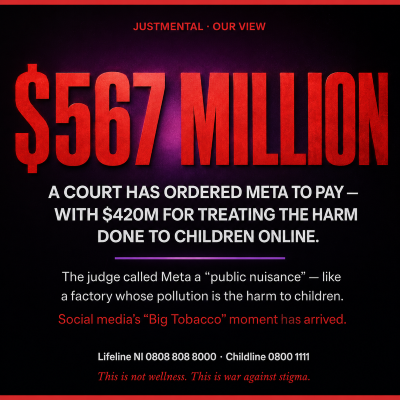
The Meta fine for child harm handed down in New Mexico this week is being called social media’s “Big Tobacco” moment, and it is worth understanding exactly what a court has now said out loud. On Thursday, a New Mexico judge ordered Meta to pay $567 million (around £421 million) into a fund to address the damage its platforms have done to children. Of that, $420 million is earmarked specifically for treating young people harmed by social media, with the rest for prevention, screening and awareness over the next five years.
It comes on top of $375 million in penalties from March, when the company was found to have broken the state’s consumer protection laws, a total of $942 million. Meta says it disagrees and will appeal.
Why the Meta fine for child harm matters beyond America
This is a United States court, and it does not bind anyone here. So why does it matter to a mental health platform in Northern Ireland? Because of what the judge actually found, and the language he used to describe it.
Judge Bryan Biedscheid compared Meta to a factory, its advertising and content the product, and, in his words, the psychological harm and exploitation of children the pollution that must be cleaned up. He ruled the company a “public nuisance” whose platforms were a significant contributing factor in a youth mental health crisis. That is a court of law, weighing substantial evidence, concluding that a social media company’s design knowingly harmed children’s mental health. Not a campaigner’s claim. A judicial finding.
For years, families who suspected that their child’s distress was bound up with what happened on a screen were told it was unprovable, or that they were imagining a link. This ruling, like the reopening of a child’s inquest to examine social media data that we covered recently, is part of a shift. The harm is being named, evidenced and, slowly, priced.
Celebration, with hard conditions
We welcome it. But we are not going to pretend it is a knockout blow, because that would not be honest. Meta made around $60 billion in profit last year. A former senior technology executive told the BBC the fine was, for a company that size, “a drop in the ocean”. Meta’s share price barely moved. And the company is appealing. A penalty a giant can absorb without noticing is a headline, not yet a deterrent.
There is also a sharper point for us here. A US state has just decided that $420 million should go towards treating the mental health harm done to its children by social media. Ask yourself what Northern Ireland spends on children’s mental health treatment, a system whose waiting figures still are not routinely published, whose primary-school counselling has been cut, and which sits bottom of the UK table for mental health funding. One New Mexico courtroom has just committed more to children’s mental health treatment than many governments manage in a year.
When will the duty of care follow the profit?
The real prize is not the money, it is the principle. That a platform can be held responsible for the foreseeable harm its design does to young minds. If that principle holds on appeal, and if it crosses the Atlantic into how the UK enforces the Online Safety Act, it could matter far more than any single cheque. Our question is the one we keep coming back to: when will the duty of care companies owe our children finally carry the same weight as the profit they make from them?
Meta built the platforms. A court has now put a number on the harm. The task now, here as much as in New Mexico, is to make sure that number is the start of accountability, not the end of it.
If you or a young person you know is struggling, you’re not alone. Lifeline NI 0808 808 8000 · Samaritans 116 123 · Childline 0800 1111 · Text SHOUT to 85258.