
Emotional Health and Wellbeing Framework: 39 Pages, £0
Emotional Health and Wellbeing Framework: 39 Pages, Not a Single Pound Committed
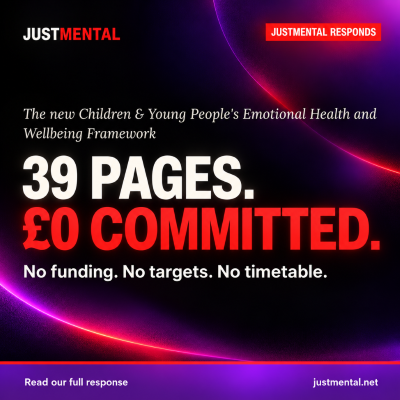
The Department of Health’s new Emotional Health and Wellbeing Framework for children and young people says many of the right things. But JustMental has read all 39 pages, and there is not a single pound committed to delivering it.

Health Minister Robbie Butler published the finalised HSC Children and Young People’s Emotional Health and Wellbeing Framework on 26 October 2026. It sets out a ten-year vision for how children, young people and families across Northern Ireland should be supported, built on prevention, early intervention and joined-up working between health, education and community services.
We welcome that ambition. Families have waited a long time for it. But a framework is not a service, and right now this one has no funding, no targets and no timetable attached.
What the Emotional Health and Wellbeing Framework gets right
There is real substance here, and it deserves credit. The Framework commits to:
- Support based on a child’s needs, rather than making help depend on a formal diagnosis.
- A single, regionally agreed referral form for every child, built around presenting needs.
- A Children and Young People’s Referral Service, where referrals are triaged by a multi-disciplinary team.
- Early support through Family Support Hubs and community networks, including for children who are waiting.
- A regional competency framework so staff are trained consistently.
It was also shaped by children, young people and families themselves. These are practical changes that parents would feel, if they are resourced.
No funding, no targets, no timetable
That is the problem. Across the whole document there is no budget figure, no named funding stream and no costing. The Framework itself says that “long-term, sustainable investment and costed implementation plans are essential to deliver the Framework’s ambitions.” Neither exists yet.
It promises “clearly measurable and reported targets”, but does not set a single one. There is no date for the implementation plan and no named body accountable for delivering it. The next step announced by the Department is a further round of engagement, not delivery.
Much of the language is conditional. Services “may need to be” reorganised, developed or funded. Even the delivery model is described only as “a suggested Model for Change”.
A system the Department calls “undeliverable”
The most striking line in the Emotional Health and Wellbeing Framework is the Department’s own admission. It says that funding services in their current state, to meet ever-increasing demand, is “undeliverable and unsustainable”.
The figures show why. At 30 June 2026, 1,731 children and young people were waiting for a CAMHS assessment, and 651 of them had waited more than nine weeks. Northern Ireland’s Youth Wellbeing Prevalence Survey found that 12.6% of children and young people experience anxiety or depression, around 25% higher than in other UK nations.
Built on a strategy that was never funded
The Emotional Health and Wellbeing Framework sits under the Mental Health Strategy 2021–2031, which was costed at £1.2 billion over ten years. By the end of 2024/25, only £12.3 million had been allocated, just 16% of what was needed for that period. The Department has confirmed that no additional funding has been allocated to the Strategy since 2021, and children’s mental health services were pushed back to a medium priority for 2027/28 and 2028/29.
Compare that with the sister Education Framework in 2021, which launched with £5 million a year from the Department of Education and a further £1.5 million a year from Health. The health version of the Emotional Health and Wellbeing Framework has launched with nothing comparable.
Where is the pathway for children in crisis?
The word “crisis” does not appear once in the Emotional Health and Wellbeing Framework. There is nothing on inpatient care or acute support. Self-harm and suicidal thoughts appear only in an appendix list of possible presenting needs, with no dedicated pathway. These are the children and families in the most urgent need, and they deserve a clear answer.
Our four questions for the Minister
We are asking Health Minister Robbie Butler:
- When will the implementation plan be published, and will that be before the May 2027 Assembly election?
- How much new, ring-fenced funding will be attached to it?
- What targets will families be able to hold the Department to?
- Where is the pathway for children in crisis?
JustMental’s verdict on the Emotional Health and Wellbeing Framework
This is the right diagnosis without a prescription. It is not box-ticking yet, because frameworks usually come before delivery plans. But on its own, it cannot shorten a single waiting list. Whether it becomes another document on a shelf depends entirely on a costed, funded implementation plan with real targets and a real date.
Mental health affects every family and every generation. A child waiting for help means a parent, a grandparent and a whole household waiting too. We will keep asking until we get answers.
You can help. Share this article, send the four questions to your MLA, and listen to the conversations we are having on JustMentalTalk. You can also read the Framework for yourself on the Department of Health website.
If you, or a young person you know, need support now, call Lifeline on 0808 808 8000. It is free and available 24 hours a day, 7 days a week, across Northern Ireland. In an emergency, call 999. |