
TAMHI Mental Health Charity: Joe Donnelly Interview
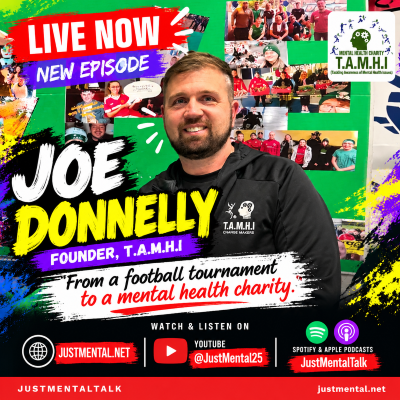
The TAMHI mental health charity began in 2011 with a football tournament held in memory of a friend. Fifteen years on, its founder Joe Donnelly is still using sport as a way into conversations that many people find hard to start.
In the latest episode of JustMentalTalk, Joe talks openly about why he and his friends set up TAMHI (Tackling Awareness of Mental Health Issues), how the charity’s games-based approach works, and what he has learned about reaching people who would never walk into a clinic.
Content note: this episode includes discussion of suicide and loss. Support details are at the end of this article.
How the TAMHI mental health charity began
TAMHI was founded in 2011 in memory of Thomas “Tammy Tucker” McLaughlin, who died by suicide in 2009. Joe describes it as the first time he had ever heard of anybody dying by suicide, and he talks about the support that gathered around Thomas’s family in the days that followed.
Two years later, Joe and his friends wanted to do something to remember Thomas, so they organised a football tournament. Local clubs soon began telling them that players were going through difficult times, from relationship breakdowns to problems with drugs. In November 2011 they started a project that put each club’s own logo on mental health information, because, as Joe explains, the same message lands differently when it comes from a club people know and trust.
He also describes an early lesson. When he approached everything through suicide prevention alone, a friend told him it would scare people off and that he should start from mental health and emotional wellbeing instead. TAMHI changed direction, and Joe believes that is a big part of why people engaged.
Why sport is the way in
TAMHI works with sports clubs, schools, community groups and workplaces. According to its website, that includes a free app and club resources, accredited training, workshops and awareness talks, and TAMHI says it supports more than 6,000 people a year.
Joe’s central point is that games make mental health less intimidating. He describes one game in which players score in a green or a red goal depending on whether a statement about mental health is a myth or a fact, followed by a conversation about what they have learned and resources to take away. In June 2025, Athletics Northern Ireland announced a partnership with TAMHI, bringing a games-based learning approach, a customised club mental health toolkit and a text support service to the athletics community.
Text TEAMMATE: free, confidential text support
Text TEAMMATE is run by TAMHI in partnership with the national text service Shout. People text the word TEAMMATE to 85258 for free, confidential support. Shout describes itself as a free, confidential, 24/7 text service for anyone in the UK who is struggling to cope, answered by trained volunteers, and says messages will not appear on your phone bill.
Joe explains that the name came from a coach who pointed out that texting a “teammate” looks no different from texting a mate, so nobody has to explain why they are on their phone. He also describes someone who used the service while waiting for a face-to-face appointment and arrived better able to talk about what was going on.
Where team sport doesn’t help
Joe is candid that team sport is not a perfect setting. He says coaches who promote mental health can be accused of hypocrisy if a young player feels left out, and he encourages coaches to have honest conversations early about selection decisions. He says TAMHI deliberately looks at the people its programmes do not reach, as well as those they do.
Funding, and what comes next
Joe is blunt about the wider picture in Northern Ireland. He says the Mental Health Strategy needs to be properly funded and that TAMHI is working with other charities on a campaign to press the Executive to back it.
Closer to home, he says the TAMHI mental health charity is developing a new club toolkit and app to help clubs measure their impact on wellbeing, a redeveloped school programme, and a golf-based programme.
His message to anyone who has lost someone: surround yourself with positive people, have a purpose, and remember that “the help does exist.”
Watch and listen
Watch the full conversation above, or find JustMentalTalk on Spotify and Apple Podcasts. To find out more about the TAMHI mental health charity, visit tamhi.org. You can read more on the JustMental blog.
Where to find support
- Text TEAMMATE to 85258 for free, confidential text support. If your life is at imminent risk, call 999.
- Lifeline: 0808 808 8000. Free, confidential and open 24 hours a day for anyone in Northern Ireland in distress or worried about someone else.
- TAMHI: support@tamhi.org or 028 9074 7437 (Monday to Friday, 9am to 5pm).

Health Minister Robbie Butler published the finalised HSC Children and Young People’s Emotional Health and Wellbeing Framework on 26 October 2026. It sets out a ten-year vision for how children, young people and families across Northern Ireland should be supported, built on prevention, early intervention and joined-up working between health, education and community services.
We welcome that ambition. Families have waited a long time for it. But a framework is not a service, and right now this one has no funding, no targets and no timetable attached.
What the Emotional Health and Wellbeing Framework gets right
There is real substance here, and it deserves credit. The Framework commits to:
- Support based on a child’s needs, rather than making help depend on a formal diagnosis.
- A single, regionally agreed referral form for every child, built around presenting needs.
- A Children and Young People’s Referral Service, where referrals are triaged by a multi-disciplinary team.
- Early support through Family Support Hubs and community networks, including for children who are waiting.
- A regional competency framework so staff are trained consistently.
It was also shaped by children, young people and families themselves. These are practical changes that parents would feel, if they are resourced.
No funding, no targets, no timetable
That is the problem. Across the whole document there is no budget figure, no named funding stream and no costing. The Framework itself says that “long-term, sustainable investment and costed implementation plans are essential to deliver the Framework’s ambitions.” Neither exists yet.
It promises “clearly measurable and reported targets”, but does not set a single one. There is no date for the implementation plan and no named body accountable for delivering it. The next step announced by the Department is a further round of engagement, not delivery.
Much of the language is conditional. Services “may need to be” reorganised, developed or funded. Even the delivery model is described only as “a suggested Model for Change”.
A system the Department calls “undeliverable”
The most striking line in the Emotional Health and Wellbeing Framework is the Department’s own admission. It says that funding services in their current state, to meet ever-increasing demand, is “undeliverable and unsustainable”.
The figures show why. At 30 June 2026, 1,731 children and young people were waiting for a CAMHS assessment, and 651 of them had waited more than nine weeks. Northern Ireland’s Youth Wellbeing Prevalence Survey found that 12.6% of children and young people experience anxiety or depression, around 25% higher than in other UK nations.
Built on a strategy that was never funded
The Emotional Health and Wellbeing Framework sits under the Mental Health Strategy 2021–2031, which was costed at £1.2 billion over ten years. By the end of 2024/25, only £12.3 million had been allocated, just 16% of what was needed for that period. The Department has confirmed that no additional funding has been allocated to the Strategy since 2021, and children’s mental health services were pushed back to a medium priority for 2027/28 and 2028/29.
Compare that with the sister Education Framework in 2021, which launched with £5 million a year from the Department of Education and a further £1.5 million a year from Health. The health version of the Emotional Health and Wellbeing Framework has launched with nothing comparable.
Where is the pathway for children in crisis?
The word “crisis” does not appear once in the Emotional Health and Wellbeing Framework. There is nothing on inpatient care or acute support. Self-harm and suicidal thoughts appear only in an appendix list of possible presenting needs, with no dedicated pathway. These are the children and families in the most urgent need, and they deserve a clear answer.
Our four questions for the Minister
We are asking Health Minister Robbie Butler:
- When will the implementation plan be published, and will that be before the May 2027 Assembly election?
- How much new, ring-fenced funding will be attached to it?
- What targets will families be able to hold the Department to?
- Where is the pathway for children in crisis?
JustMental’s verdict on the Emotional Health and Wellbeing Framework
This is the right diagnosis without a prescription. It is not box-ticking yet, because frameworks usually come before delivery plans. But on its own, it cannot shorten a single waiting list. Whether it becomes another document on a shelf depends entirely on a costed, funded implementation plan with real targets and a real date.
Mental health affects every family and every generation. A child waiting for help means a parent, a grandparent and a whole household waiting too. We will keep asking until we get answers.
You can help. Share this article, send the four questions to your MLA, and listen to the conversations we are having on JustMentalTalk. You can also read the Framework for yourself on the Department of Health website.
If you, or a young person you know, need support now, call Lifeline on 0808 808 8000. It is free and available 24 hours a day, 7 days a week, across Northern Ireland. In an emergency, call 999. |