
James McClean Mental Health Comments: Why ‘Weakness’ Is the Most Dangerous Word
A footballer said speaking out would make him weak. We think that belief is exactly what’s putting men in the ground, and we’re not angry at him. We’re angry at the lie.
James McClean’s mental health comments this week have landed hard across Northern Ireland and Ireland, and we’re not going to pretend otherwise, they stopped us in our tracks. In an interview with Paul Kimmage, published in the Sunday Independent on 18 October, the Derry City player explained why he has never tried therapy: “as a man I would see that as a weakness that I’d have to speak to someone about my feelings; my emotions.”
Let’s be honest about how that feels to read, especially here. Frustrating. Deflating. For anyone who has clawed their way back from the edge by finally talking to someone, it stings. But we want to be very clear about where our frustration is aimed, and where it isn’t. The James McClean mental health conversation this week is a chance, not just a flashpoint.
Our frustration is with the belief, not with James McClean
We are not here to pile on a man. James McClean is, by every public account, going through an extraordinarily difficult period, his own family has spoken about the daily battle he’s facing, and these remarks came out of a painful and public dispute with his club. A man who is clearly struggling telling the world that opening up would be a “weakness” is not the villain of this story. He is the clearest proof we have ever been handed that the stigma is real, it runs deep, and it reaches even the strongest-looking among us.
That’s why the James McClean mental health story matters so much. He is an influential figure, particularly for young men who grew up watching him. When someone that visible says speaking out is weakness, boys who are already frightened to talk hear permission to stay silent. And silence, in this part of the world, has a body count.
Why the James McClean mental health story actually costs lives
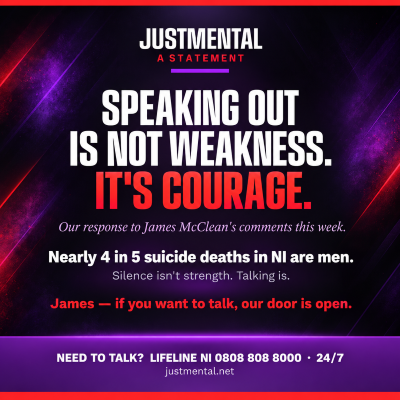
Here is the hard arithmetic. In 2024, males made up 79.3% of all suicide deaths registered in Northern Ireland, nearly four in every five, according to NISRA figures confirmed in a Minister of Health written answer. Across Western countries, men are more than three times as likely to die by suicide than women. The single biggest risk factor isn’t that men don’t feel things. It’s that too many have been taught, from boyhood, that saying so out loud makes them less of a man.
That is the exact belief in McClean’s words. And it is not a personal quirk, it is the quiet, inherited rule that helps keep those numbers where they are. Challenging it is the whole reason JustMental exists.
Speaking out is not weakness. It is the bravest thing a person can do
Walking into a room and telling a stranger that you’re not okay, when everything in you has been trained to say “I’m grand”, is not weakness. It is one of the hardest, most courageous things a person will ever do. It takes more guts than staying silent ever has. Every man we have ever had on JustMentalTalk who found his way back will tell you the same thing: the strength wasn’t in holding it in. It was in finally letting it out.
We want to say this directly, and we mean it without an ounce of sarcasm: James, if you ever want to talk, on or off camera, publicly or privately, our door is open. No cameras if you don’t want them. No agenda. We’d be genuinely glad to.
Credit where it’s due
Derry City FC moved quickly and well, stating that “these views do not reflect our core values or beliefs” and that the club “actively encourages anyone facing mental health challenges to speak openly, seek support and know they never have to face such challenges alone.” The club has accepted an invitation to meet the Men’s Action Network (MAN), a Derry charity with more than thirty years of work behind men’s mental health. MAN’s chairperson Michael Lynch struck exactly the right note: this isn’t “about attacking anyone personally.” It never should be.
So here’s our ask of you
If you take one thing from this, take this: the word “weakness” has done enough damage. Bin it. If you’re a man reading this and you’ve been carrying something on your own, you don’t have to any more. If you’re not a man, because this is not just a men’s issue, it affects every walk of life, the same is true for you. Talk to someone. A mate, a GP, a helpline, a therapist. Anyone. It is not weakness. It is you choosing to stay.
The James McClean mental health debate will fade from the headlines within days. The belief underneath it won’t, unless we keep chipping away at it. This is not wellness. This is war against stigma, and words like the ones we heard this week are exactly what we’re fighting. Find support and our full resources here.
If you are struggling, or worried about someone, support is available right now, 24/7: Lifeline NI 0808 808 8000 · Samaritans 116 123 · CALM 0800 58 58 58 · Text SHOUT to 85258.