
Social Media Ban Rejected Again: Starmer Summons Big Tech, But Where Are the Consequences?
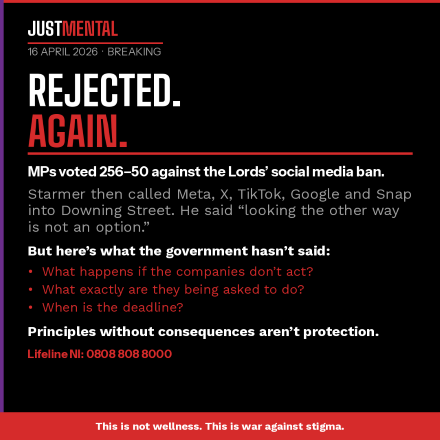
Yesterday, MPs voted for the second time against banning social media for under-16s. The result was 256 to 150, a majority of 106 in favour of the government’s position.
The Lords had backed the ban twice. The Commons has now rejected it twice. The bill that sparked this debate, the Children’s Wellbeing and Schools Bill, returns to the Lords in what has become an increasingly weary cycle of parliamentary ping-pong.
Yesterday evening, hours after the vote, Prime Minister Sir Keir Starmer called senior leaders from Meta, X (formerly Twitter), TikTok, Google (YouTube) and Snap into Downing Street. He told them, according to the government’s own press release, that “looking the other way is not an option.”
It is a strong phrase. JustMental agrees with it entirely.
What the government has not yet published is what happens if the companies do look the other way. No specific demands. No measurable commitments. No deadline. No stated consequences for failure.
That is what we need to talk about.
What the Government Has Done
To be fair to Starmer, this is not nothing. The government has taken powers, through the Children’s Wellbeing and Schools Bill, that would allow ministers to act by secondary legislation rather than waiting for new primary law once the consultation concludes. That means, in theory, action could come faster than the traditional legislative route.
Some social media companies have already made voluntary changes. According to Downing Street, some platforms have disabled autoplay for children by default, given parents greater screen time controls, and introduced overnight curfews. These are not trivial steps.
The government’s consultation, Growing Up in the Online World, has received more than 45,000 responses, including from nearly 6,000 young people. It closes on 26 May 2026, with the government promising a response by summer 2026.
And Starmer’s statement in Downing Street contained language that, if he means it, has real implications. He said: “The consequences of failing to act are stark. I will take whatever steps necessary to keep children safe online.”
JustMental is holding him to that.
What the Government Has Not Done
The Downing Street press release is notable for what it does not contain.
There are no specific demands. The government says it will “set out principles and values” to the companies. Principles are not requirements. Values are not rules.
There is no stated deadline for the companies to act. The consultation closes in May. The government has promised a response “by summer.” Summer is not a date. And in politics, deadlines without consequences are invitations to delay.
There are no consequences for non-compliance. What happens if Meta continues to do what it has done for a decade, promise action, implement minimal change, and monetise attention regardless of age? The Downing Street statement does not say. The government has powers it could use. It has not yet used them.
This is not unique to this government or this Prime Minister. It is a pattern in how British politics deals with Big Tech, summits, statements, consultations, and then further summits. Meanwhile, the platforms continue to operate.
The Three Questions the Government Must Answer
JustMental is a small, independent platform based in Northern Ireland. We do not have the power to compel government policy. What we do have is a responsibility to ask the right questions on behalf of the people this issue affects directly.
On the basis of yesterday’s vote and today’s Downing Street meeting, there are three questions that need public answers:
1. What specifically are the social media companies being asked to do?
Not principles. Not values. Specific, measurable actions. Disable algorithmic recommendation for under-16s? Implement robust age verification within a set timeframe? Remove features designed to exploit compulsive use? The government must publish what it is asking for, not just that it is asking.
2. When must they act?
A consultation closes in May. A response is promised “by summer.” That could mean June or it could mean September. Children are being harmed in the meantime. The government must publish a specific date by which it expects action from the platforms and a specific date by which it will impose regulatory measures if that action is not forthcoming.
3. What are the consequences if they don’t?
Starmer said the consequences of failing to act are stark. For whom? Under the Online Safety Act 2023, Ofcom can fine companies up to £18 million or 10% of global annual turnover for breaches. In Australia, companies that fail to comply with the social media ban face penalties of up to A$49.5 million. What is the UK’s equivalent threat? Until that is stated clearly and publicly, Big Tech has no incentive to move faster than the slowest legally defensible pace.
Why This Matters for Mental Health
JustMental exists to fight the stigma around mental health and to hold the systems that fail people to account. The social media and children’s mental health debate is not an abstract policy question. It is a live emergency.
The link between social media use and mental health harm in children is well-documented. Eating disorder presentations in adolescents have risen sharply during the period social media became central to young people’s lives. Self-harm rates in teenage girls have increased. Molly Russell died in 2017 after viewing self-harm and suicide content on Instagram and Pinterest. A California court has found Meta and Google liable for intentionally building addictive platforms that harmed a young person’s mental health.
In Northern Ireland, where JustMental is based, the situation is compounded by the highest suicide rate in the UK and some of the longest mental health waiting times in these islands. Young people here are not less vulnerable to the harms of algorithmic social media than young people anywhere else. They may be more so.
We are not arguing that a blanket ban is the only answer. Reasonable people disagree on that, and the concerns raised by children’s charities about driving young people into less regulated spaces are legitimate.
We are arguing that the government must say, in public, what it is prepared to do if the companies fail to protect children, and when. Summits and principles are not protection. Deadlines and consequences are.
What Happens Next
The Children’s Wellbeing and Schools Bill now returns to the House of Lords, where peers must decide whether to accept the Commons’ position or insist on the ban once more. Lord Nash has already indicated he will continue to fight for the amendment.
The government’s consultation closes on 26 May 2026. JustMental urges anyone who has not yet responded to do so. The link is at gov.uk/government/consultations/growing-up-in-the-online-world.
The government has said it will respond by summer 2026. We will be watching.
This is not wellness. This is war against stigma.
If you are struggling with your mental health right now: Lifeline NI: 0808 808 8000, free, 24 hours a day.