
Suicide Statistics 2025: A Worrying Three-Year Standstill
Suicide Statistics 2025: Three Years With No Real Progress in England and Wales
This article discusses suicide. If you are struggling, Lifeline is free and available 24/7 on 0808 808 8000 in Northern Ireland, and Samaritans are available on 116 123 across the UK and Ireland.
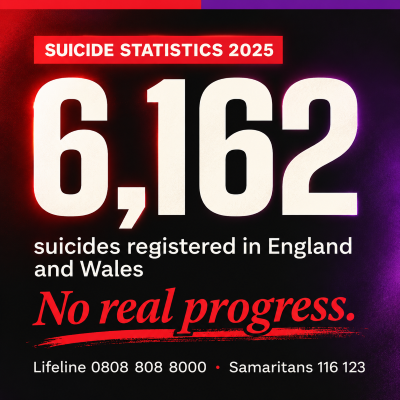
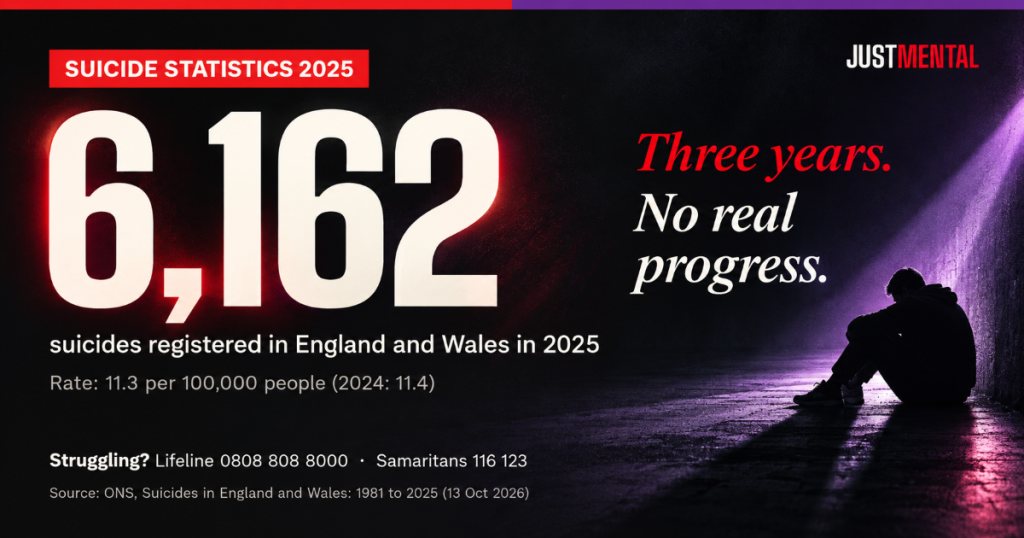
The suicide statistics 2025 release from the Office for National Statistics (ONS), published on 13 October 2026, shows that 6,162 suicide deaths were registered in England and Wales last year. That is an age-standardised rate of 11.3 deaths per 100,000 people, against 11.4 in 2024. Put simply, the rate has barely moved in three years.
Behind every one of those numbers is a person, and a family, a workplace and a community left changed. Spread across the year, 6,162 registrations works out at around 17 a day.
What the suicide statistics 2025 show
These are the main points from the ONS suicide figures for England and Wales:
- 6,162 suicides were registered in 2025, a rate of 11.3 per 100,000 people, compared with 6,190 (11.4) in 2024.
- The rate in England was 11.1 per 100,000 for the third year in a row.
- The rate in Wales fell from 15.7 to 14.3 per 100,000.
- The rate for men was 17.5 per 100,000 and for women 5.5, both similar to 2024.
- People aged 50 to 54 had the highest rate of any age group, as they have every year since 2021.
Three years with no real progress
Set against the two years before, the suicide statistics 2025 show how little suicide rates in England and Wales have moved:
Year registered | Suicides registered | Rate per 100,000 |
2023 | 6,069 | 11.3* |
2024 | 6,190 | 11.4 |
2025 | 6,162 | 11.3 |
*ONS first published the 2023 rate as 11.4. It was revised to 11.3 after updated population estimates. In 2024, ONS described the 2023 rate as the highest in nearly 25 years.
Over the longer term, ONS says rates generally fell from 1981 to 2007, held fairly steady until 2015, and have generally risen since 2017. There is an important caveat. In July 2018, the standard of proof coroners use to conclude that a death was suicide was lowered from “beyond all reasonable doubt” to “on the balance of probabilities”. ONS has concluded this likely increased the number of deaths registered as suicide, so part of the rise reflects how deaths are recorded.
Registrations versus when deaths happened
Every suicide in England and Wales goes through a coroner before it can be registered. In 2025 the median wait was 188 days in England and 249 days in Wales, so many deaths registered last year happened earlier. Counting by when deaths occurred instead, ONS records 5,626 suicides in 2024, a rate of 10.4, and says that rate has been fairly stable since 2018. Stable, at that level, is still not good enough.
Midlife: where the suicide statistics 2025 keep pointing
Men remain about three times more likely than women to die by suicide (17.5 against 5.5 per 100,000). That gap is real and it matters. But the age pattern reaches far beyond one group:
- Among men, those aged 50 to 54 had the highest rate, at 28.0 per 100,000 (27.3 in 2024).
- Among women, those aged 45 to 49 had the highest rate, at 7.7 per 100,000 (7.9 in 2024).
Both peaks fall in midlife. The figures do not explain why, and we will not pretend they do. But midlife is rarely the focus of mental health campaigns, and the data says it should be.
Suicide is not only a men’s issue, or only a young person’s issue. It touches every age, every background and every community, which is exactly why JustMental is for everyone.
Where you live matters
The suicide statistics 2025 also show wide gaps across England. The North East again had the highest rate, at 14.0 per 100,000, and London the lowest, at 7.3. The biggest rise was in the South West, up from 11.3 to 13.7. The East Midlands saw the biggest fall, from 12.1 to 10.2. Five of the nine English regions saw their rate fall.
What about Northern Ireland suicide statistics?
Northern Ireland’s figures are produced separately by the Northern Ireland Statistics and Research Agency (NISRA), and ONS describes them as highly comparable with its own. The latest published figures are for 2024: 290 suicides were registered in Northern Ireland, an age-standardised rate of 17.4 per 100,000, compared with 11.4 in England and Wales that year. Almost 8 in 10 were men.
Registration delays matter here too. Only 87 of the 290 deaths registered in 2024 happened in 2024, so one year’s figure can be pushed up as inquests catch up. Even so, the three-year rolling average of registered suicides rose to 238.0 in 2024.
NISRA has confirmed to JustMental that Northern Ireland’s suicide statistics for 2025 are planned for publication on 19 November 2026. The report will include analysis by year of occurrence, meaning when deaths actually happened, as well as when they were registered. That should make Northern Ireland’s trends easier to read, and we will report the figures carefully when they arrive.
What needs to happen next
A flat line in the suicide statistics 2025 is not good news. It means the same number of families losing someone, year after year. Ahead of next year’s Assembly election, JustMental will be asking candidates three questions:
- How will you make sure suicide prevention funding in Northern Ireland is spent where it makes a difference, and published so the public can see it?
- NISRA is adding analysis by year of occurrence this year. Will you make sure that information is used to measure whether suicide prevention in Northern Ireland is actually working?
- What will you do to make crisis support easier to reach for people of every age, including people in midlife?
These questions sit alongside our questions on Right Care, Right Person in Northern Ireland, because how people in crisis are supported is part of the same conversation.
If you are struggling right now
You do not have to be at crisis point to reach out. Lifeline is free, confidential and open 24 hours a day, 7 days a week, on 0808 808 8000 for anyone in Northern Ireland (textphone 18001 0808 808 8000). Samaritans are available any time on 116 123 across the UK and Ireland. If someone’s life is in immediate danger, call 999.
If it helps to hear people talk honestly about hard times, every JustMentalTalk podcast episode is free to listen to, and you can read more about why lived experience matters in our World Mental Health Day 2026 article.